Showing posts with label Alan Watts. Show all posts

Monday, March 11, 2013

ON NOT PACKAGING THE SKY

Bamboo Grove, Hasedera Buddhist Temple, Kamakura, Japan
Photo by Urashimataro

Imagine a world in which you are liberated from all of the labels that have been imposed on you throughout your life.  Imagine a world in which that elusive experience we call "enlightenment," "awakening," or "higher consciousness" is not to be found in another time and place, but, instead, is to be found right under your nose — in this moment, this place, with all of your imperfections.  

These are two of the matters discussed by Alan Watts in his introduction to Zen: The Supreme Experience.  Having just reread that portion of the book, I am providing a few quotes that I find extremely liberating.  

I must begin with a word of explanation.  Some time ago I was in a radio station as a participant in a panel discussion on man and religion.  Before we went on air, the moderator asked all the participants around the table to introduce themselves.  I was sitting on his left, and the man on his right began: Rabbi So-and-so, Jewish; Reverend So-and-so, Protestant minister; Father So-and-so, Catholic priest; Doctor So-and-so, logical positivist and so on.  When it was my turn, I said, 'Alan Watts, no label." Immediately, there was an outcry: "You aren't being fair."
     I say 'No label' sincerely, because although I speak a great deal about Zen, I never refer to myself as a 'Zen-ist" or as a Buddhist because that seems to me like packaging the sky.
     There is an excellent reason for the absence of a definition of Zen.  All systems that have preconceived views of what the human being is and what the world ought to be categorize existence under labels.  People who have Jehovah-like ideas of an order that they wish to impose on reality also use labels.  But when one's concern is not to order the world around but to understand it, to experience it and to find out about it, you give up this superior attitude and become receptive.
     Then, instead of knowing all about it, you come to know it directly.  But this 'knowing' is difficult to talk about because it has to be felt.  It is the difference between eating dinner and eating the menu.
•  •  •  •  •


We may in the past have had marvelous spiritual experiences — almost everyone in this world is lucky enough to experience satori once in their life . . . Ever afterwords, you search for that experience again: 'I want it that way.'  You once had a wonderful girlfriend, and now you want another just like her.  That way of thinking blocks the possibility of meeting with life.  This is why meditation for Zen practitioners and Taoists means affirming that your everyday mind is the way — not the mind you ought to have or the mind you might have if you practiced acceptance or concentration.  We want you to look at it just the way it is right now — that's Buddha.  Just like that.
     Of course, many will say this is nonsense.  'The way I am now is degraded, ordinary, unevolved, not spiritual, decadent.'  Yet remember this phrase from the Zenrin poem:  'At midnight, the sun brightly shines.' All right, it is midnight now.  This, at this moment, is the awful dark thing we think we are.  Yet the poem also says, 'This is Buddha.' 
     A monk once asked a Zen master, 'What is Zen?'  The master replied, 'I don't feel like answering now.  Wait until there is nobody else around and I'll tell you.'  Some time later the monk returned to the master and said, 'There is nobody around now, Master.  Please tell me about Zen.' The master took him into the garden and said, 'What a long bamboo this is!  What a short bamboo that is!'
     So you may be a long bamboo, you may be a short bamboo.  You may be a giraffe with a long neck or a giraffe with a short neck.. What you are now is the very point.  There is no goal because all goals are in the future. There is only the question of what is.  Look and see; see how, of its own accord, it comes to your eye. 
Alan Watts, No Label 


Saturday, February 2, 2013

DETACHMENT: AT THE CENTER OF THE CIRCLE

The perfect man employs his mind as a mirror; it grasps nothing; it refuses nothing; it receives, but does not keep.
Chuang-tzu 

"Detachment" is not a term that is greeted with much favor in American culture.  In common parlance, the word suggests aloofness, emotional frigidity, or insensitivity to the concerns of others or one's community.  Zen Buddhism, however, does not view detachment with such negativity.  Indeed, detachment is regarded as central to the preservation of one's core balance and integrity.  In his fine book, Become What You Are, the great Zen teacher Alan Watts explained it this way:
Detachment means to have neither regrets for the past nor fears for the future; to let life take its course without attempting to interfere with its movement and change, neither trying to prolong the stay of things pleasant nor to hasten the departure of things unpleasant.  To do this is to move in time with life, to be in perfect accord with its changing music, and this is called Enlightenment.  In short, it is to be detached from both the past and future and to live in the eternal Now.  For in truth neither past nor future have any existence apart from this Now; by themselves they are illusions.  Life exists only at this very moment, and in this moment it is infinite and eternal.  
The old sage Lao-tzu was, of course, the master of detachment.  "Just stay at the center of the circle," he said, "and let all things take their course." Tao Te Ching (translation by Stephen Mitchell).


Monday, January 7, 2013

ACCEPTANCE


Mysteriously, wonderfully, I bid farewell to what goes, I greet what comes; for what comes cannot be denied, and what goes cannot be detained.
Chuang-Tzu

The way of acceptance and spiritual freedom is found not by going somewhere but by in going, and the stage where happiness can be known is now, at this very moment, at the very place where you happen to stand.  It is in accepting fully your state of soul as it is now . . . . The point is not to accept it in order that you may pass on to a "higher" state, but to accept because acceptance in itself is that "higher" state, if such it may be called. 
                                                         Alan Watts

Life has no other discipline to impose, if we would but realize it, than to accept life unquestioningly. Everything we shut our eyes to, everything we run away from, everything we deny, denigrate or despise, serves to defeat us in the end. What seems nasty, painful, evil, can become a source of beauty, joy and strength, if faced with an open mind. Every such moment is a golden one for him who has the vision to recognize it as such.

Henry Miller 

Saturday, July 24, 2010

WABI-SABI


Old Peacock Feather

One of the books that has captured my imagination in recent weeks is Wabi-Sabi for Artists, Designers, Poets and Philosophers.  Published in 1994, this small book was written by Leonard Koren, a trained architect who, according to the publisher's note, had never previously built anything, except an eccentric Japanese tea house, "because he found large, permanent objects too philosophically vexing to design." 

Wabi-sabi is a Japanese aesthetic ideal that is rooted to some extent in Zen Buddhism.  Like Zen, it is difficult to precisely define because it abhors structures, criteria, and formulas. According to Koren, however, wabi-sabi encompasses --

     the beauty of things imperfect, impermanent,
     and incomplete;

     the beauty of things modest and humble; and

     the beauty of things unconventional.

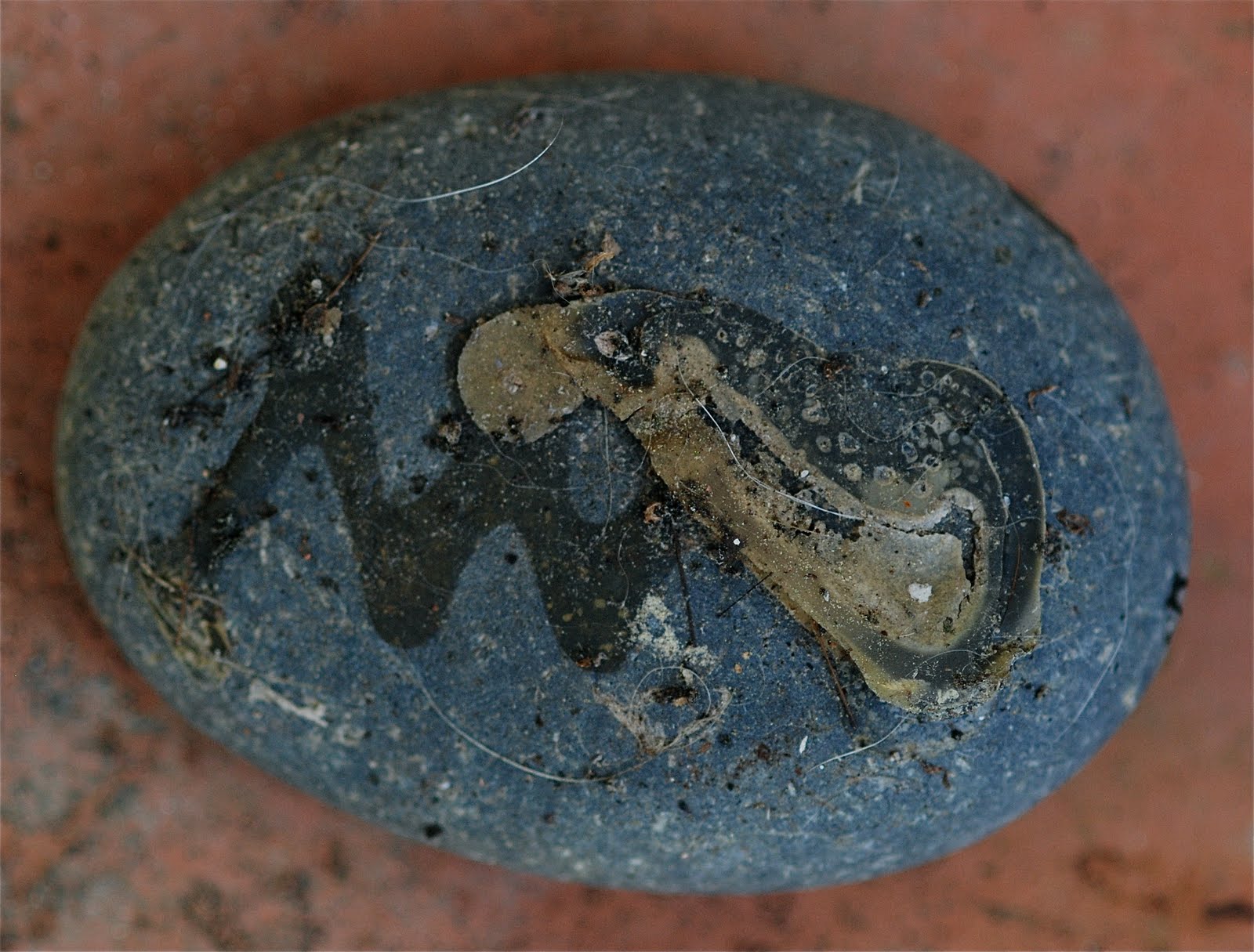
Looking around the outside of my home in the last few days, I have found several objects or groups of objects that seem to radiate wabi-sabi beauty: the remains of a weathered peacock feather that was arbitrarily stuck in a flower pot several years ago; odd pieces of colorful sea glass gathered by my wife from various beaches; a weathered stone with interesting patterns; a bird's abandoned nest still containing a broken shell that once contained new life; and a metal lattice strip succumbing to rust. Each of these objects is imperfect and each is a testament to the impermanence of all things.

Pieces of Weathered Sea Glass

In its celebration of things that are imperfect, impermanent, incomplete, modest, humble, or unconventional, wabi-sabi stands in opposition to the western aesthetic ideal.  With its Greek heritage, the western ideal reveres perfection and disparages "flaws"; venerates that which is perceived to be permanent and frowns upon that which is perceived to be transitory; and favors "completed" things over those that are slow works in progress.  Westerners may occasionally find the modest and humble to be charming, but we seldom equate it with beauty.  Nor are we inclined to ascribe beauty to unconventional things; more often than not, the unconventional is suspected of "ugliness," the cardinal aesthetic sin.

Weathered Stone

Understandably, the western aesthetic ideal may seem more rational to westerners, particularly Americans. Like Zen, however, wabi-sabi is decidedly anti-rational, which is to say that it abhors any habit of systematic, conditioned thinking that separates the thinker from the reality of the present moment.  As a result, the focus of wabi-sabi is never on some abstract, intellectual notion of what could be or should be, but rather on the singular beauty emanating from that which is at any given point in time.

Bird's Abandoned Nest with Cracked Shell

While wabi-sabi is often associated with ambiance, the physical environment, or the beauty of things, it is anchored in larger philosophical propositions that can also provide the framework for one's entire life.  Those propositions, as I understand them, would include the following:

-- One should accept and embrace impermanence, not only because it is the undeniable state of all things, including the universe, but also because it is the condition that gives value to anything at any given moment.

-- One should see and appreciate the beauty of every stage of transition, the old no less than the new, the broken no less than the whole, the tarnished and tattered no less than the slick and fine.

-- One should discover wonder and beauty in unexpected places and things, perhaps even places or things that are suspected of being "ugly."  As Koren says, "beauty can be coaxed out of ugliness," and is often found in "the minor and the hidden, the tentative and the ephemeral: things so subtle and evanescent they are invisible to the vulgar eye."

-- One should live simply, modestly, and frugally by getting rid of everything that is unnecessary, including nonessential material things as well as illusions of wealth, success, status, power, and luxury.

-- One should always favor the intuitive over the logical, nature over technology, the present over the future, natural materials over the man-made materials, modesty over ostentation, and the inner life over the outer life.

None of this is meant to suggest that wabi-sabi would require one to live in a perennial state of austerity or deprivation; indeed, Buddha himself advocated "the middle way."  The key, as Koren essentially states in his book, is to pare down to the essence of life without removing its poetry.


Rusting Metal Lattice Strip


Sunday, May 2, 2010

ZEN AND THE BIRDS OF APPETITE

When I grow weary with the world, I find myself going to the bookshelf that holds my volumes of Alan Watts, Henry Miller, and Thomas Merton, three seekers who would have surely enjoyed each other's company. I find comfort in the mere titles of their books, e.g., Behold the Spirit and Still the Mind by Watts; The Wisdom of the Heart and Stand Still Like a Hummingbird by Miller; Seeds of Contemplation and Mystics and Zen Masters by Merton.  When I pull down any one of these volumes and open its covers, I find myself at peace instantly, knowing that I will soon be transported back to my center, the still place that is my ground of being.

Recently, I returned to Merton's Zen and the Birds of Appetite, a fascinating book that explores the author's study of Zen and its relationship with various structural systems, especially religion.  The title itself raises a variety of questions.  What does Merton have in mind when he refers to "Zen," a word that is extremely difficult to define and is often misused?  Who are the "birds of appetite"?  And what do the birds of appetite have to do with the world with Zen?  These questions are answered by Merton, of course, but the reader must first spend a few moments reflecting on the author's brief opening note, from which the title of the book is drawn:  
Where there is carrion lying, meat-eating birds circle and descend.  Life and death are  two.  The living attack the dead, to their own profit.  The dead lose nothing by it.  They gain too, by being disposed of.  Or they seem so, if you must  think in terms of gain and loss.  Do you then approach the study of Zen with the idea that there is something to be gained by it? This question is not intended as an implicit accusation.  But it is, nevertheless, a serious question.  Where there is a lot of fuss about "spirituality," "enlightenment" or just "turning on," it is often because there are buzzards hovering around the corpse.  This hovering, this circling, this descending, this celebration of victory, are not what is meant by the Study of Zen -- even though they may be a highly useful exercise in other contexts.  And they enrich the birds of appetite.
     Zen enriches no one.  There is no body to be found.  The birds may come and circle for a while in the place where it is thought to be.  But they soon go elsewhere.  When they are gone, the "nothing," the "no-body" that was there, suddenly appears. That is Zen.  It was there all the time but the scavengers missed it, because it was not their kind of prey. 
  At first glance, this opening note always appears cryptic and vexing. Reading it slowly, however, I begin to see where Merton is going with this. He is essentially stating that most of us are "birds of appetite," who are circling the skies constantly in search of a visible form that appears to offer the spiritual nutrition we require. Sometimes it's a  religion or some other belief system; sometimes it's a defined philosophy; sometimes it's a new kind of spirituality or a new "ism."  In almost every case, however, we appear to be seeking sustenance from something that has form and structure -- something that can be easily understood, measured, defined, and labeled by the analytical machinery of our conditioned minds.  And whatever that something is, our egos expect to be enriched by it, to gain something from it, just like the birds of prey that hover around the corpse of a dead animal.

Merton is not calling upon us to abandon all forms and structures; he recognizes that words, rituals, traditions, and other cultural systems are appropriate in certain contexts.  He fears, however, that our increasing obsession with forms is blinding us to the ultimate reality that lies beyond those forms -- the mystical experience of life itself, the formless, nameless, mysterious wonder that underpins everything.

This is where Zen can be useful.  In its purest sense, Zen is simply a heightened state of consciousness that is not dependent upon any kind of form or structure -- religious, cultural, or otherwise.  Since it is neither a form, a structure, nor a system, it does not stand  in opposition to any form, structure, or system.  It is not contrary to any religious or cultural traditions; nor is it contrary to the forms through which those traditions are practiced.  As Merton says, it is "trans-religious, trans-cultural, and trans-formed."  In short, Zen permits one to see and experience the ultimate reality that lies beyond the forms and structures.

If this sounds esoteric -- and I think that it does -- it is probably because Zen, by it very nature, does not lend itself to either systematic thinking or verbal expression. It can only be experienced, personally and directly. Paradoxically, one must be both mindful and mindless -- mindful in the sense of paying attention to what is actually happening in the present moment, and mindless in the sense of not judging and labeling what is happening.  As an old Zen saying goes, "better to see the face than to hear the name."

Zen can be practiced anywhere, anytime, under any circumstances. "Everyday Zen," say the masters, is the best.  At a minimum, Zen returns us to a place where the ultimate reality of life, in all of its complexity, can be fully experienced and accepted, with neither judgment nor resistance. Under the best of circumstances, one might even experience  occasional moments of transcendence.  "To attain this experience," writes Merton, " is to penetrate the reality of all that is, to grasp the meaning of one's own existence, to find one's true place in the scheme of things, to relate perfectly to all that is in a relation of identity and love."