Thursday, September 16, 2010

A DAY IN THE CITY — REDUX


BACK TO NORMAL — I HOPE


To the best of my knowledge, my the "blog feed" problems have been resolved, and my fellow bloggers are being alerted when new postings are published.  Thanks for your patience.

In the process of trying to solve my technical problems, I made some design changes in the blog, using one of Blogger's new templates.  Among other things, the new template is wider and provides more creative space, which gives a little breathing room to both the text and photos.  From my perspective, it makes the blog a little easier on the eye.  I hope you will agree.

* * * * * 

A DAY IN THE CITY — REDUX


I spent yesterday in Washington, primarily at the East Wing of the National Gallery of Art.  Inspired by Bonnie's recent post on Old Montreal, I thought it might be fun to share some of the day's delights with you, beginning with the East Wing itself (above), which was designed by the renowned architect, I.M. Pei.


As I entered the East Wing and descended one level, my eyes were riveted to Wall Drawing No. 681C, by the American artist, Sol LeWitt.


Just a few steps away was a small gallery adorned by three works of the abstract expressionist painter, Mark Rothko.


This is a wonderful, small stabile created by Alexander Calder and titled Vertical Constellation with Bomb (1943).  I love the way that the shadows add to this composition.  As I looked at this work, I began to wonder if shadows, in the Jungian sense, also improve the compositions of our individual selves.


Turning left from Vertical Constellation with Bomb, I saw this collection of small Calder stabiles and mobiles.  Again, notice how the shadows provide a sense of depth and play.


As I proceeded back to the main level of the East Wing, I found myself drawn, as moth to flame, to the moving walkway that transports people from the main part of the East Wing to the lovely cafe and gift shop.  Except for the floor level and a portion of one wall, the area of the moving walkway is rounded, cavernous, and lined with lights that change in appearance with every passing second.  The lights, coupled with the movement of the walkway itself, allowed me to create the above photo and the ones just below.  The thing that caught my eye, and which I tried to capture in these photos, was the sense that we are each on a mysterious journey through time, drawn toward something that is both luminous and divine.


The ground level floor of the East Wing, like the exterior of the building itself, is a feast of geometrical design — walls and windows at sharp angles, intense colors against neutral tones of stone.


From this vantage point on the third floor, one can get a sense of the play of light, shadows, and angles in the building.  In the foreground, of course, is another Calder mobile (Untitled, 1976).


This is essentially the same view, zoomed in a bit.  The sculpture in the recessed area beneath the bridge is by David Smith.  Note also the small Giacometti sculpture, Walking Man II (1960), on the bridge.


This is a view from the ground level of the museum, looking toward the entrance.


This wonderful little gallery features some of the cut-outs, papiers coupes, that Matisse created during the last fifteen years of his life.


This gallery is devoted to modern American art.  My purpose here is to simply demonstrate how effective the East Wing curators are in their use of color, design, and lighting to display their collections.


Shortly after noon, I walked down the Capitol Mall and had lunch as "Metropolitan," a lovely restaurant owned and operated by the National Gallery.


After lunch, I went to the main building of the National Gallery to see a new photo exhibition: "Beat Memories: The Photography of Allen Ginsberg."  In an age of digital color, it was great to see these candid black and white photos of Ginsberg and his celebrated friends, Jack Kerouac, William S. Burroughs, Neal Cassady, and the poet, Gregory Corso.


After seeing the Ginsberg exhibit — and treating myself to a cappuccino and a wicked tart aux pommes — I left the main building of the National Gallery and headed for my car.  Just as I was leaving, however, I caught my reflection in one of the glass pyramids that can be seen in the header photo of the East Wing.  Normally, I do not take photos of myself.  I took the above photo, however, because the composition, which I just stumbled upon, seemed to be a metaphor for how we often see each other in fragmented and distorted light, half concealed and half revealed.  That leads me to why I value art so much.  I believe that art speaks a truth that words alone can never express.  "Art is a lie," said Picasso, "that makes us realize the truth."

Note of Photos:  Click on photos to enlarge for easier viewing.


Wednesday, September 15, 2010

A DAY IN THE CITY


I spent yesterday in Washington, primarily at the East Wing of the National Gallery of Art.  Inspired by Bonnie's recent post on Old Montreal, I thought it might be fun to share some of the day's delights with you, beginning with the East Wing itself (above), which was designed by the renowned architect, I.M. Pei.


As I entered the East Wing and descended one level, my eyes were riveted to Wall Drawing No. 681C, by the American artist, Sol LeWitt.


Just a few steps away was a small gallery adorned by three works of the abstract expressionist painter, Mark Rothko.


This is a wonderful, small stabile created by Alexander Calder and titled Vertical Constellation with Bomb (1943).  I love the way that the shadows add to this composition.  As I looked at this work, I began to wonder if shadows, in the Jungian sense, also improve the compositions of our individual selves.


Turning left from Vertical Constellation with Bomb, I saw this collection of small Calder stabiles and mobiles. Again, notice how the shadows provide a sense of depth and play.


As I proceeded back to the main level of the East Wing, I found myself drawn, as moth to flame, to the moving walkway that transports people from the main part of the East Wing to a lovely cafe and gift shop.  Except for the floor level and a portion of one wall, the area of the moving walkway is rounded, cavernous, and lined with lights that change in appearance with every passing second.  The lights, coupled with the movement of the walkway itself, allowed me to create the above photo and the ones just below.  The thing that caught my eye, and which I tried to capture in these photos, was the sense that we are each on a mysterious journey through time, drawn toward something that is both luminous and divine.


The ground level floor of the East Wing, like the exterior of the building itself, is a feast of geometrical designs — walls and windows at sharp angles, intense colors against the neutral tones of stone.


From this vantage point on the third floor, one can get a sense of the play of light, shadows, and angles in the building.  In the foreground, of course, is another Calder mobile (Untitled, 1976).
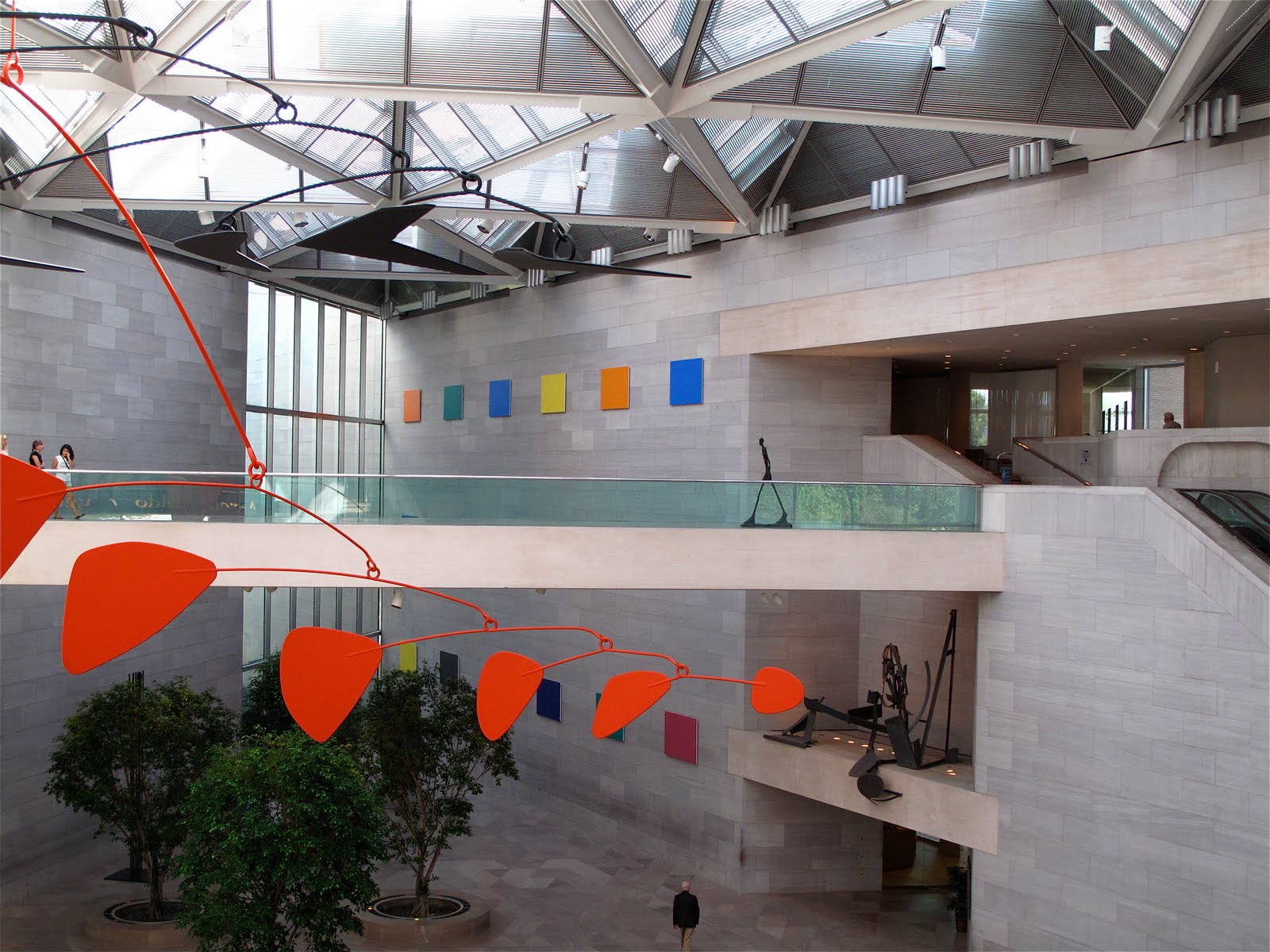


This is essentially the same view, zoomed in a bit.  The sculpture in the recessed area beneath the bridge is by David Smith.  Note also the small Giacometti sculpture, Walking Man II (1960), on the bridge.


This is a view from the ground level of the museum, looking toward the entrance.


This wonderful little gallery features some of the cut-outs, papiers coupes, that Henri Matisse created during the last fifteen years of his life.


This gallery is devoted to modern American art.  My purpose here is to simply demonstrate how effective the East Wing curators are in their use of color, design, and lighting to display their collections.


Shortly after noon, I walked down the Capitol Mall and had lunch at "Metropolitan," a lovely restaurant owned and operated by the National Gallery.  


After lunch, I went to the main building of the National Gallery to see a new photo exhibition:  "Beat Memories: The Photography of Allen Ginsberg."  In an age of digital color, it was great to see these candid black and white photos of Ginsberg and his celebrated friends, Jack Kerouac, William S. Burroughs, Neal Cassady, and the poet, Gregory Corso.


After seeing the Ginsberg exhibit — and treating myself to a cappuccino and a wicked tart aux pommes — I left the main building of the National Gallery and headed for my car.  Just as I was leaving, however, I caught my reflection in one of the glass pyramids that can be seen in the header photo of the East Wing. Normally, I do not take photos of myself.  I took the above photo, however, because the composition, which I just stumbled upon, seemed to be a metaphor for how we often see each other in fragmented and distorted light, half concealed and half revealed.  That leads me to why I value art so much.  I believe that art speaks a truth that words alone can never express.  "Art is a lie," said Picasso, "that makes us realize the truth."

Note on Photos:  Click on photos to enlarge for easier viewing.

Sunday, September 12, 2010

BEAUTY IN UNEXPECTED PLACES

           
 Everything beckons to us to perceive it,
murmurs at every turn 'Remember me!'
A day we passed, too busy to receive it
will unlock us all its treasury.

Rilke
"Everything Beckons To Us"

"Everything beckons to us to perceive it," says Rilke — EVERYTHING — and I take his counsel seriously.  In my daily journeys, I do my best to observe not only the larger forms that dominate the landscape, but also the smaller fragments that either make up or adorn these forms.  I try to look beyond the obvious, to see the overlooked and forgotten.  I try to "see beyond what is seen," for lack of a better expression, and to become intimate with everything, including the lost, the fallen, and the degraded.  Above all, I resist the temptation to ignore things that are not easily identifiable.  In my experience, true beauty seldom lends itself to names, labels, or classifications.

In this posting, I invite you see some of the things that have crossed my visual path in recent days and to reflect upon the words of various writers, photographers, and painters on the fascinating subject of "seeing."  If you suspend your natural desire to understand what has been photographed, and focus, instead, on the texture, lines, and hues of the compositions, I think you will be reminded that nature itself is our greatest artist.


Seeing, in the finest and boldest sense, means using your senses, your intellect, and your emotions.  It means encountering your subject matter with your whole being.  It means looking beyond the labels of things and discovering the remarkable world around you.
Freeman Patterson


The precision of naming takes away from the uniqueness of seeing.

Pierre Bonnard 


In photography, the smallest thing can be a great subject.  The little, human detail can become a leitmotiv.
Henri Cartier-Bresson


Whether he an artist or not, the photographer is a joyous sensualist, for the simple reason that the eye traffics in feelings, not in thoughts.


Walker Evans


If you look at a thing 999 times, you are perfectly safe;  if you look at it for the 1000th time, you are in danger of seeing it for the first times.
C.K. Chesterton 


Blessed are they who see beautiful things in humble places where other people see nothing.


Camille Pissarro


If only we could pull out our brain and use only our eyes.
Picasso


Art is not what you see, but what you make others see.


Edgar Degas 


The hardest thing to see is what is in front of our eyes.


Goethe


Once you really commence to see things, then you really commence to feel things.


Edward Steichen


It's not what you look at that matters, it's what you see.


Thoreau


While there is perhaps a province in which the photograph can tell us nothing more than what we see with our own eyes, there is another in which it proves to us how little our eyes permit us to see.

Dorothea Lange


Anything that excites me for any reason, I will photograph; not searching for unusual subject matter, but making the commonplace unusual.


Edward Weston 


You cannot depend on your eyes when your imagination is out of focus.


Mark Twain


The common eye sees only the outside of things, and judges by that, but the seeing eye pierces through and reads the heart and the soul, finding there capacities which the outside didn't indicate or promise, and which the other kind couldn't detect.


Mark Twain


The bells and stones have voices but, unless they are struck, they will not sound.


Chuang-Tzu 


Notes on Photos:  (1) sailboat rudder and keel; (2) work boat transom; (3) sailboat keel and rudder; (4) work boat transom; (5) underside of a sailboat hull; (6) work boat transom; (7) underside of a sailboat hull; (8) work boat transom; (9) drainage marks below waterline on sailboat hull; (10) work boat transom; (11) barnacles and peeling paint on underside of sailboat hull; (12) underside of bow of sailboat; (13) work boat transom; (14) rusty chain found in boatyard; (15) section of painted window found in airport corridor; (16) dry-rotting industrial hose; (17) rusting bottom of metal chair; (18) patina of tarnished copper weather vane discovered on grounds of an antique store.  


Wednesday, September 8, 2010

ON BEGINNING A PAINTING — OR THE NEXT PHASE OF ONE'S LIFE

Richard Diebenkorn
Berkeley #19, 1954
The University of Arizona Museum of Art

Before embarking upon what I believe was the most productive and fascinating period of his work, the American painter, Richard Diebenkorn, made a list of ten "guidelines," for lack of a better word, that he believed should drive the creative process.  If you are a painter or some other type of artist, you will probably find, as I have, great comfort and wisdom in Diebenkorn's approach.  One need not be an artist, however, to find wisdom in these words. Through the years, I have come to believe that Diebenkorn's advice is as relevant to the creation of a good life as it is to the creation of good art.  See what you think as you read the document that Diebenkorn simply titled, "Notes to myself on beginning a painting."

1.  Attempt what is not certain.  Certainty may or may not come later.  It may then be a valuable delusion.

2.  The pretty, initial position which falls short of completeness is not to be valued — except as a stimulus for further moves.

3.  Do search.  But in order to find other than what is searched for.

4.  Use and respond to the initial fresh qualities but consider them absolutely expendable.

5.  Don't "discover" a subject — of any kind.

6.  Somehow don't be bored — but if you must, use it in action.  Use its destructive potential.

7.  Mistakes can't be erased but they move you from your present position.

8.  Keep thinking about Polyanna.

9.  Tolerate chaos.

10. Be careful only in a perverse way.

Diebenkorn's advice resonates deeply with me at both an artistic level and a personal level, and my favorite points are the sixth, ninth, and tenth:  the need to use the "destructive potential" of boredom; the need to tolerate chaos; and the need to be careful only in a perverse way.  What about you?  Do find anything in Diebenkorn's list that resonates with your personal or artistic life?

Friday, September 3, 2010

THE FOUR QUARTETS

T. S. Eliot

If there is a single poem that draws me back into its folds year after year, it is T.S. Eliot's masterpiece, The Four Quartets.  I go there in times of deep questioning, knowing that I will always find solace; I go there when I think that I have found answers, knowing that my answers will be tested and destroyed if false; I go there for the sheer music and arrangement of words that prod, delight, and challenge me to pay attention to the reality — not the ideal — of my life.

From my perspective, The Four Quartets is essentially the journal of a questing soul.  In words  that delight as much as they confound, the poem speaks to those questions that lurk silently in every human heart:  What are the unmitigated truths of our lives?  Is there anything that we can rely upon?  What are the consequences of denying our authenticity and living lives designed by others?  Can we trust the wisdom of the wisdom-givers?  How do we find peace in a spinning world?  How do we confront the impermanence of everything, including not only our lives, but the present moment?  What shall we do with the autumn of life?  Is there anything that is eternal, beyond the realm of time?

The poem is too long to quote in full.  I have chosen a few excerpts, however, that offer a small glimpse into the mind and razor-sharp intellect of Eliot.  I would be interested in knowing if any of you discover, as I have, something in these words or images that resonates with your own lives.

Each change in color represents a separate excerpt. Enjoy!

The Four Quartets

Time present and time past
Are both perhaps present in time future,
And time future contained in time past.
If all time is eternally present
All time is unredeemable.
What might have been is an abstraction
Remaining a perpetual possibility
Only in a world of speculation.
What might have been and what has been
Point to one end, which is always present.
Footfalls echo in the memory
Down the passage we did not take
Towards the door we never opened
Into the rose-garden.

At the still point of the turning world.  
Neither flesh nor fleshless;
Neither from nor towards; at the still point, 
there the dance is . . .

Time past and time future
Allow but a little consciousness.
To be conscious is not to be in time . . . 


In my beginning is my end.  In succession
Houses rise and fall, crumble, are extended,
Are removed, destroyed, restored, or in their place
Is an open field, or a factory, or a by-pass.
Old stone to new building, old timber to new fires,
Old fires to ashes, and ashes to the earth
Which is already flesh, fur and faeces,
Bone of man and beast, cornstalk and leaf.
Houses live and die: there is a time for building
And a time for living and generation
And a time for the wind to break the loosened pane
And to shake the wainscot where the field-mouse trots
And to shake the tattered arras woven with a silent motto.


Do not let me hear
Of the wisdom of old men, but rather of their folly,
Their fear of fear and frenzy, their fear of possession,
Of belonging to another, or to others, or to God.
The only wisdom we can hope to acquire 
Is the wisdom of humility; humility is endless.

I said to my soul, be still, and wait without hope
For hope would be hope for the wrong thing; wait without love
For love would be love of the wrong thing; there is yet faith
But the faith and the love and the hope are all in the waiting.
Wait without thought, for your are not ready for thought:
So the darkness shall be the light, and the stillness the dancing.

To arrive where you are, to get from where you are not,
You must go by the way wherein there is no ecstasy.
In order to arrive at what you do not know,
You must go by a way which is the way of ignorance.
In order to possess what you do not possess,
You must go by the way of dispossession.
In order to arrive at where you are not,
You must go through the way in which you are not,
And what you do not know is the only thing you know
And what you own is what you do not own
And where you are is where you are not.

There is only the fight to recover what has been lost
And found and lost again and again: and now, under conditions
That seem unpropitious.  But perhaps neither gain nor loss.
For us, there is only the trying.  The rest is not our business.

Love is most nearly itself
When here and now cease to matter.
Old men ought to be explorers
Here and there does not matter
We must be still and still moving . . .

We had the experience but missed the meaning.

For most of us, there is only the unattended
Moment, the moment in and out of time,
The distraction fit, lost in a shaft of sunlight,
The wild thyme unseen, or the winter  lightening
Or the waterfall, or music heard so deeply
That it is not heard at all, but you are the music
While the music lasts.  These are only hints and guesses,
Hints followed by guesses: and the rest
Is prayer, observance, discipline, thought, and action.

Whatever we inherit from the fortunate
We have taken from the defeated.

What we call the beginning is often the end
And to make an end is to make a beginning.

We shall not cease from exploration
And the end of all our exploring
Will be to arrive where we started
And know the place for the first time.

Quick now, here, now, always —
A condition of complete simplicity
(Costing not less than everything)
And all shall be well and
All manner of thing shall be well
When the tongues of flame are in-folded
Into the crowned knot of fire
And the fire and the rose are one.


Dreamfields