Wednesday, January 11, 2012

MYSTERY AND WONDER

We wake, if ever at all, to mystery.
Annie Dillard

Driven by a desire to be completely liberated from the cultural provincialism of the American south, where I was born and spent my early years, I have dedicated much of my life to the pursuit of knowledge.  Seldom, if ever, have I questioned the metaphorical truth of Shakespeare's observation in Henry VI that "ignorance is the curse of God, knowledge the wing wherewith we fly to heaven . . . "

Now, however, as I approach the end of my seventh decade, I'm less inclined to see ignorance and knowledge as some kind of binary choice.  Ignorance and knowledge can only be intelligently discussed in relative terms, and they usually walk hand in hand throughout our lives.  Regardless of one's level of education, what one knows is always dwarfed by what one does not know.  Our most profound questions always seem hydra-headed; slay one and two more will arise in its place.  Perhaps Plato's observation still holds true: "The learning and knowledge that we have, is, at the most, but little compared with that of which we are ignorant."

And consider this:  In his recent book—The 4% Universe: Dark Matter, Dark Energy, and the Race to Discover the Rest of Reality—science historian and writer Richard Panek states that only four percent of the universe consists of matter that makes up you, me, the earth, the stars, the planets, and the galaxies, everything within the ambit of our current knowledge.  The remaining ninety-six percent, referred to by cosmologists as dark matter and dark energy, is unknown.  What's even more stunning, many of the world's most prominent scientists believe that it will continue to remain unknown.

In short—with all of our scientific advancements, with all of our technological discoveries, with all of our penetrations into the worlds of quantum physics—we know only a small fraction of the universe in which we spin our lives.  What we know is wrapped in the larger mystery of what we do not know and may never know.

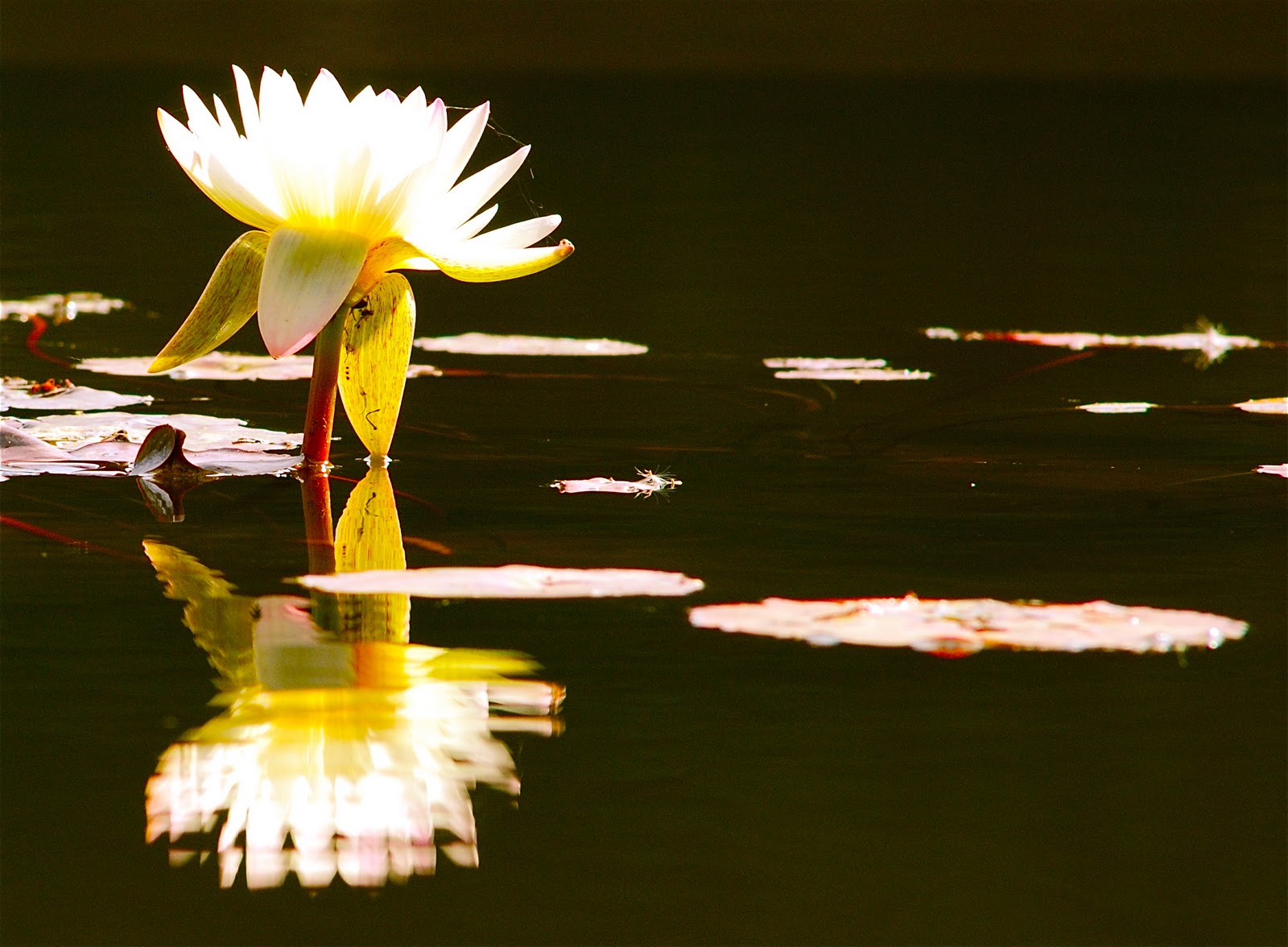
Set forth below are some interesting observations on the the subject of learning and knowledge on the one hand, versus mystery and wonder on the other.  I have punctuated these quotes with abstract photos in which I have attempted to capture at least a hint of some of the mystery of which I speak.  With the exception of the header photo, all of these images were created by panning my camera at slow shutter speeds across man-made lights against dark backgrounds.  Limited light against a background of infinite darkness seems to be an appropriate metaphor for our place in this mysterious universe.


The possession of knowledge does not kill the sense of wonder and mystery.  There is always more mystery.
Anais Nin

Until we accept the fact that life itself is founded in mystery, we shall learn nothing.
Henry Miller


A wonderful fact to reflect upon, that every human creature is constituted to be that profound secret and mystery to every other.
Charles Dickens

A day spent without the sight or sound of beauty, the contemplation of mystery, or the search of truth or perfection, is a poverty-stricken day; and a succession of such days if fatal to human life.
Lewis Mumford


Mystery is a resource, like coal or gold, and its preservation if a fine thing.
Tom Cahill

I do not at all understand the mystery of grace—only that it meets us where we are and does not leave us where it found us.
Anne Lamott 


Any genuine philosophy leads to action and from action back again to wonder, to the enduring fact of mystery.
Henry Miller

The approach of a man's life out of the past is history, and the approach of time out of the future is mystery.  Their meeting is the present, and it is consciousness, the only time life is alive.  The endless wonder of this meeting is what causes the mind, in its inward liberty of a frozen morning, to turn back and question and remember.  The world is full of places. Why is it that I am here?
Wendell Berry


The fairest thing we can experience is the mysterious.  It is the fundamental emotion which stands at the cradle of true art and true science.  He who knows it not and can no longer wonder, no longer feel amazement, is as good as dead.
Albert Einstein 

God does not die on the day when we cease to believe in a personal deity, but we die on the day when our lives cease to be illumined by the steady radiance, renewed daily, of a wonder, the source of which is beyond all reason.
Dag Hammarskjold 


The final mystery is oneself.
Oscar Wilde

Saturday, January 7, 2012

AMOR FATI: LOVING ONE'S FATE


Amor Fati—"Love Your Fate," which is in fact your life.

Friedrich Nietzsche

Nietzsche was the one who did the job for me.  At a certain moment in his life, the idea came to him of what he called 'the love of your fate.' Whatever your fate is, whatever the hell happens, you say, 'This is what I need.'  It may look like a wreck, but go at it as though it were an opportunity, a challenge.  If you bring love to that moment—not discouragement—you will find the strength is there.  Any disaster you can survive is an improvement in your character, your stature, and your life. What a privilege!  This is when the spontaneity of your own nature will have chance to flow.
Then, when looking back at your life, you will see that the moments which seemed to be great failures followed by wreckage were the incidents that shaped the life you have now.  You'll see that this is really true.  Nothing can happen to you that is not positive.  Even though it looks and feels at the moment like a negative crisis, it is not.  The crisis throws you back, and when you are required to exhibit strength, it comes. 
Joseph Campbell


In every life, some things can and should be changed, while other things cannot or should not be changed.  It's also true that, with every passing year, the second category grows larger, while the first grows smaller.  Increasingly, therefore, we must choose the way we respond to things that cannot or should not be changed—things that may be classified as our "fate."  Typically, we resist our fate, all to no good end, but Nietzsche and Campbell remind us that we always have a better alternative.  We can not only accept our fate, but actually come to love it—to embrace it without judgment, to regard it as foundational to the unfolding of our unique lives.  We can become "yes-sayers," as Nietzsche said, people who say yes to everything in life that cannot be changed for the better.  It's a great approach, I think, to what scientist and writer Jon Kabat-Zinn has called "full catastrophe living."


THE THING IS
Ellen Bass

                                         To love life, to love it even
                                         when you have no stomach for it
                                         and everything you've held dear
                                         crumbles like burnt paper in your hands,
                                         your throat filled with the silt of it.
                                         When grief sits with you, its tropical heat
                                         thickening the air, heavy as water
                                         more fit for gills than lungs:
                                         when grief weights you like your own flesh
                                         only more of it, an obesity of grief, 
                                         you think, How can a body withstand this?
                                         Then you hold life like a face, 
                                         between your palms, a plain face,
                                         no charming smile, no violet eyes,
                                         and you say, yes, I will take you
                                         I will love you, again.


AMOR FATI
LOVE YOUR FATE

Sunday, January 1, 2012

MEASURES OF HAPPINESS


Let me begin my first post of the new year by declaring that this is happiness for me: a wet dog, bathed in the golden light of a late December sun, breaking through the surf and calling upon me to forget myself and return to the world of divine play.  This is where life takes place, she says, here in this moment, this tide, this light, this chance to fall in love with everything once again.  There is still an adventurous child in me—a small core that has not yet fallen prey to cynicism—and my wet dog understands this completely.

What is this thing we call "happiness," this elusive mental state that we wish for ourselves and one another on the first day of every year?  Most of us can say what happiness is not—and it's seldom what we imagined in our youth—but we still have great difficulty getting a fix on what it is.  We are in good company, of course, for the great poets and philosophers have always reminded us that happiness can never be easily defined.  It is unpredictable, elusive, fleeting in nature—and therein may lie its charm, for if one could find happiness and possess it at will, it would probably lose its essential quality of being happiness.  Perhaps Thoreau said it best:
Happiness is like a butterfly: the more you chase it, the more it will elude you, but if you turn your attention to other things, it will come and sit softly on your shoulder.
While reading some new poetry anthologies during the past few days, I have come across three poems in which happiness has been discovered in unexpected places—which, as many of us have learned, is where it is usually found.  In So Much Happiness, Naomi Shihab Nye reminds us that "happiness floats," that it "doesn't need anything," and that virtually everything "could wake up filled with possibilities." In Orkney / This Life, Andrew Greig tells us that happiness can only be found in the present reality of this life.  "This is where I want to live," declares Greig, "close to where the heart gives out, ruined, perfected . . ."  Finally, in a poem titled Happiness, Raymond Carver recalls the unexpected pleasure of simply watching two paper delivery boys on their morning rounds, an experience that left him with a profound sense that happiness is a fleeting moment of such beauty that "death and ambition, even love," are irrelevant.

Read and enjoy!  There is no better gateway to the new year—or maybe even happiness—than poetry.


SO MUCH HAPPINESS
                                                    Naomi Shihab Nye


                      It is difficult to know what to do with so much happiness.
                      With sadness there is something to rub against,
                      a wound to tend with lotion and cloth.
                      When the world falls in around you, you have pieces to
                           pick up,
                      something to hold in your hands, like ticket stubs
                           of change.


                      But happiness floats.
                      It doesn't need you to hold it down.
                      It doesn't need anything.
                      Happiness lands on the roof of the next house, singing,
                      and disappears when it wants to.
                      You are happy either way.
                      Even the fact that you once lived in a peaceful tree house
                      and now live over a quarry of noise and dust
                      cannot make you unhappy.
                      Everything has a life of its own,
                      it too could wake up filled with possibilities
                      of coffee cake and ripe peaches,
                      and love even the floor which needs to be swept,
                      the soiled linens and scratched records . . .


                      Since there is no place large enough
                      to contain so much happiness,
                      you shrug, you raise your hands, and it flows out of you
                      into everything you touch.  You are not responsible.
                      You take no credit, as the night sky takes no credit
                      for the moon, but continues to hold it, and share it,
                      and in that way be known.


                                              ORKNEY / THIS LIFE
                                                      Andrew Greig


                             It is big sky and its changes,
                             the sea all round and the waters within.
                             It is the way sea and sky
                             work off each other constantly,
                             like people meeting in Alfred Street,
                             each face coming away with a hint
                             of the other's face pressed in it.
                             It is the way a week-long gale
                             ends and folk emerge to hear
                             a single bird cry way high up.


                             It is the way you lean to me
                             and the way I lean to you, as if
                             we are each other's prevailing;
                             how we connect along our shores,
                             the way we are tidal islands
                             joined for hours then inaccessible,
                             I'll go for that, and smile when I
                             pick sand off myself in the shower.
                             The way I am an island loch to you
                             when a clatter of white whoops and rises . . .


                             It is the way Scotland looks to the South,
                             the way we enter friends' houses
                             to leave what we came with, or flick
                             the kettle's switch and wait.
                             This is where I want to live,
                             close to where the heart gives out,
                             ruined, perfected, an empty arch against the sky
                             where birds fly through instead of prayers
                             while in Hoy Sound the ferry's engines thrum
                             this life this life this life.


                                                       Happiness
                                                   Raymond Carver

                             So early it's still almost dark out.
                             I'm near the window with coffee, 
                             and the usual early morning stuff
                             that passes for thought.
                             When I see the boy and his friend
                             walking up the road
                             to deliver the newspaper.
                             They wear caps and sweaters,
                             and one boy has a bag over his shoulder.
                             They are so happy
                              they aren't saying anything, these boys. 
                              I think if they could, they would take
                              each other's arm.
                              It's early in the morning, 
                              and they are doing this thing together.
                              They come on, slowly.
                              The sky is taking on light,
                              though the moon still hangs pale over the water.
                              Such beauty that for a minute
                              death and ambition, even love, 
                              doesn't enter into this.
                              Happiness.  It comes on
                              unexpectedly.  And goes beyond, really,
                              any early morning talk about it.


"Everything," says Naomi Shihab Nye, can "wake up filled with possibilities of coffee cake and ripe peaches, and love even the floor which needs to be swept . . . "  That would include both me and my wet dog, the Zen master, especially on this New Year's Day.  What a wonderful year it's going to be!


Happy New Year to Everyone!


Tuesday, December 20, 2011

MERRY CHRISTMAS TO ALL!


Merry Christmas to all of my great friends in the blogging community!  Your names are too numerous to mention individually, but you know who you are.  Throughout this year, you have lifted my spirits and enriched my life with your words, your images, your ideas, and your creativity.  Staying connected with you has been nothing less that soul-work for me, and I am deeply grateful for your stabilizing presence is a world that often seems to be imploding.

I extend my heartfelt wishes that you and your families will find great love, peace, and joy during the holiday season.  May you reap the abundant treasures envisioned by John O'Donohue in his fine blessing, For Equilibrium:

                             Like the joy of the sea coming home to shore,
                             May the relief of laughter rinse through your soul.

                             As the wind loves to call things to dance,
                             May your gravity be lightened by grace.

                             Like the dignity of moonlight restoring the earth,
                             May your thoughts incline with reverence and respect.

                             As water takes whatever shape it is in,
                             So free may you be about who you become.

                             As silence smiles on the other side of what's said,
                             May your sense of irony bring perspective.

                             As time remains free of all that it frames,
                             May your mind stay clear of all it names.

                             May your prayer of listening deepen enough
                             To hear in the depths the laughter of God.


PEACE AND JOY,
HERE AND NOW!

Thursday, December 15, 2011

MEDITATIONS ON NATURE


If there is one thing clear about the centuries dominated by the factory and the wheel, it is that although the machine can make anything from a spoon to a landing-craft, a natural joy in earthly living is something it never has and never will be able to manufacture.

Henry Beston


Nature uses only the longest threads to weave her patterns, so that each small piece of the fabric reveals the organization of the entire tapestry.

Richard Feynman 


Adopt the pace of nature: her secret is patience.

Ralph Waldo Emerson


What would the world be, once bereft
Of wet and of wildness?  Let them be left,
O let them be left, wildness and wet;
Long live the weeds and the wilderness yet.

Gerard Manley Hopkins


Those who dwell among the beauties and mysteries of the earth are never alone or weary of life.

Rachel Carson 


Everybody needs beauty as well as bread, places to play in and pray in, where nature may heal and give strength to body and soul.
 John Muir


Only spread a fern-frond over a man's head and worldly cares are cast out, and freedom and beauty and peace come in.
John Muir 


There is in all visible things an invisible fecundity, a dimmed light, a meek namelessness, a hidden wholeness.  This mysterious unity and integrity is wisdom, the mother of all . . . There is in all things an inexhaustible sweetness and purity, a silence that is a fountain of action and joy.  It rises up in wordless gentleness, and flows out to me from the unseen roots of all created being.
Thomas Merton 


Look!  Look!  Look deep into nature and you will understand everything.

Albert Einstein


I would feel more optimistic about a bright future for man if he spent less time proving that he can outwit Nature and more time tasting her sweetness and respecting her seniority.
E.B. White 


The earth laughs in flowers.

Ralph Waldo Emerson


I begin to see an object when I cease to understand it.

Henry David Thoreau


Wisdom begins in wonder.

Socrates


                                         i thank You God for this most amazing
                                         day: for the leaping greenly spirit of trees
                                         and a blue dream of sky; and for everything
                                         which is natural which is infinite which is yes

e.e. cummings


Nature does not hurry, yet everything is accomplished.

Lao Tzu


The world will never starve for wonder, but only for want of wonder.

C.K. Chesterton


After you have exhausted what there is in business, politics, conviviality, and so on—have found that none of these finally satisfy, or permanently wear—what remains?  Nature remains.

Walt Whitman


Notes on Photos:  All photos were taken in the last couple of days here in coastal South Carolina. 

Monday, December 5, 2011

MUSIC AS A THIN PLACE


Wolfgang Amadeus Mozart
by
Johann Nepomuk della Croce

Lately, I have been thinking a great deal about "thin places," a concept which has its roots in Celtic spirituality.  According to my understanding, "thin places" are those places where the boundary between the material world and the divine realm becomes so thin, so porous and permeable, that we can experience the total fullness of reality.  A thin place can be a geographical place, of course, but it can also be a poem, a person, a work of art, a piece of music, an experience with nature—any situation that lifts the veil, dissolves our preconceptions, and offers a glimpse, if only fleetingly, of the divine mystery of the non-material world.

While reading What I Believe, by the iconoclastic Swiss theologian Hans Kung, I came across a passage that speaks eloquently, I think, of the thin places created by certain music.  Mozart is the focus of Kung's musical passion, but what he says strikes me as relevant to other types of music, indeed any music that opens one's eyes to the formless reality beyond the intellectual forms (preconceptions, e.g.) that permeate our thinking.  While I can find thin places in certain classical music, I can also find them in other types of music.

So on with the quote.  Here is Hans Kung speaking of his experience with the music of Mozart:
Sometimes when studying or relaxing, I open myself to the music, let it flow into me, and abandon myself completely to it, not only with the intelligence of the head, which is necessary for scholarship, but with the intelligence of the heart which binds, integrates, communicates totality.
It is this experience that draws me back to this music time and again.  If I am listening to Mozarts' music utterly and intensely, without outside disturbances, alone at home or sometimes at a concert, my eyes close and I suddenly feel that the body of sound is no longer outside me but part of my being.  It is the music that now embraces me, permeates me and resounds from within.  What has happened?  I sense that I am wholly turned inwards with eyes and ears, body and spirit: the I is silent and everything external, any subject—object split, ceases to exist.  The music is no longer outside me but is what embraces me, permeates me, brings me happiness from within, fulfills me completely.  The phrase that occurs to me is: 'In it we live and move and have our being.'
This is a saying from the New Testament, from the apostle Paul's speech on the Areopagus in Athens, where he speaks of seeking and finding God, who is not remote from any of us, in whom we live and move and are . . . Truly more than any other music, with its sensual-nonsensual beauty, power and clarity Mozart's music seems to show how fine and narrow the boundary is between music, the most unobjective of all the arts, and religion, which has always especially had to do with music. Both, though different, point to the ultimately unspeakable, to the mystery.  And though music must not become a religion of art, the art of music is the most spiritual of all symbols for that 'mystical sanctuary of our religion,' of which Mozart once spoke, the divine itself.
The conclusion is that Mozart's music is not proof of God but even more not a pointer to pessimism and nihilism.  On the contrary, sensitive listeners will sometimes find themselves opening up, in that reasonable trust which transcends reason.  With this fine hearing they may then perceive a wholly Other in the pure, utterly internalized sound, say, of the adagio of the clarinet concerto; the sound of the beautiful in its infinity, indeed the sound of the infinite that transcends us and for which 'beautiful' is not a word.  So music is a 'tuning in' to a higher harmony. 
Six words literally jump out of this last paragraph for me—"that reasonable trust which transcends reason."  Thin places, including music which dissolves the boundaries of thought, are good places to find that trust.

Sunday, November 13, 2011

SANCTUARY AND BOOKS


Inspired by recent postings of several other bloggers, including my friend, Ruth, author of Synch-ro-ni-zing, I have decided to pull back the curtain on the study in which I read, write, and ponder questions that will never be answered.  In the spirit of full disclosure, however, I must confess that that these photos—taken on the morning of my departure for a few months in South Carolina— suggest a level of neatness that is rarely found in my little sanctuary.  On most days, the study is cluttered with books on the floor, mail and periodicals on the desk, an myriad other items that a more organized person would have disposed of promptly and properly (e.g., abandoned coffee cups, opened maps, computer cables I don't understand, and shoes taken off the night before).


My study (header photo) is a converted bedroom that is furnished with a few of my paintings, a photo of my first yellow lab ("Baci"), three bookcases, and the desk and credenza that are holdovers from my days of practicing law.  


Other than books, furniture, and computer equipment, I do not keep many objects in my study.  On these bookshelves, however, you can see a few objects that I value for spiritual reasons.   On the middle shelf is a hand-thrown begging bowl (made by a potter friend), which is a daily reminder of how little one actually needs to live; a scallop shell (symbol of the Camino de Santiago de Compostela), which is a reminder that every day and every step is part of a pilrimage; and small carved statue of Buddha, which is a reminder that I can always choose peace.  


Beneath the shelves is a beautiful stone with a single word carved into its center: "Create."  Few words in my vocabulary hold as much power and possibility as this word.  


I have finally abandoned the the idea that I can retain all of my favorite books in my house.  Many are in storage and I am finally becoming more comfortable with the idea of donating books to the local library unless there is some reason for not doing so.  What remains in my study are those volumes which invite me to return to their pages frequently—poetry, a few favorite novels, art books, travel books, and a variety of books relating to philosophy, theology, and ancient wisdom traditions.


For the most part, my books are not organized according to author, subject matter, or any other standard.  On this shelf, however, are treasured volumes of two of my favorite authors, Henry Miller and Thomas Merton.  This is the default shelf when I find myself teetering toward despair.  Any volume on this shelf is likely to clear my vision and lift my spirits.


As you can see from this shelf, my reading habits are very eclectic.  Lots of books on religious and spiritual traditions—Buddhism, Zen, Taoism, Hinduism, and the origins of Christianity.  I see some volumes by Wendell Berry, Annie Dillard, and Annie Lamott, all of whom I admire.  Others on this shelf are are Krishnamurti, Dante, Emerson, and the poet Stanley Kunitz.  Just in front of the small replica of a bicycle I once owned is my tattered but treasured copy of the great Kazantzakis novel, Zorba the Greek.


This shelf has a bit of almost everything—more Henry Miller, an anthology of the poetry of Jorge Luis Borges, several volumes on yoga, a two-volume anthology of American poetry, the collected works of Yeats, more works by Wendell Berry, a selection Nietzsche's works, and several books on the art of writing.  I also see my copy of Jon Kabat-Zinn's fine book, Full Catastrophe Living.  I'm especially fond of this title because it reminds me of one of the main reasons I have always loved books: They prepare us for the full measure of life, including all of the catastrophes that will be encountered by each of us.


I'm hopelessly addicted to travel books and travel essays, some of which are found on the top shelf here.  I also see a favorite book by Ken Wilber, a compassionate philosopher whom I greatly admire;  several works by Rilke, including Letters to a Young Poet, a small volume which I read at least once every year; and one of my books by Karen Armstrong, a contemporary theologian who has written a number of fine books, including a biography of Buddha.

Looking closer at the bookshelves in the second photo of this post, one can see that I have a rather insatiable interest in various wisdom traditions.  Underpinning this interest is a lifelong desire to understand the common threads that are found in all of these traditions.


On this shelf is a novel, The Sea, by John Banville, a fine Irish novelist whom I have only discovered in the past few years.  There is also a copy of Crossing to Safety, a novel by the late Wallace Stegner, whose work I also greatly admire. Between these novels are several spiritual books,  including the Tao Te Ching and more Krishnamurti.  I also see a couple of French books—additional evidence of my being an unabashed Francophile.


For what I consider to be enlightened discussions of Christianity, I usually turn to iconoclasts such as some of those represented on this shelf—Paul Tillich, Meister Eckhart, and John Shelby Spong.  I also greatly admire the work of Eckhart Tolle, who, like Aldus Huxley in The Perennial Philosophy, has done much to elucidate the core principles that underpin all of the great religions and spiritual traditions.  I'm especially fond of Eckhart Tolle's book, A New Earth.


Some of my Alan Watts books are found on this shelf.  The writings of Watts were instrumental in introducing me to Zen several decades ago.  Also found on this shelf are several different translations of the meditations of Marcus Aurelius, as well as a volume of the Upanishads and some additional works by Krishnamurti.

Well, there you have it—a few glimpses into my sanctuary, one of the places where I can usually find refuge from the outside world and passage into the interior realm. For those who might have the inclination, I would recommend this little exercise, not only because it is always interesting to see the contents of other people's bookshelves, but also because one can discover so much about oneself my simply looking at the favorite books of one's life.  A bookshelf is a better mirror of oneself that a piece of glass.