Friday, July 15, 2016

WALKING THE OFFA'S DYKE PATH: PART 1


I started this post last summer after completing a 10-day hike of about 80% of the Offa's Dyke Path, a U.K. National Trail that weaves northward along the border that separates Wales and England, from the estuary of the River Severn in the south and the Irish Sea in the north.  I'm not sure why I never got around to completing the post and publishing it, but it may have had something to do with a few traumatic experiences along the way. Among other things, I encountered more aggressive bulls than I had in previous walking trips in the U.K, and on the second day out, I came very close to being severely injured (or worse) when I was charged by a very mean and dangerous bull.  For all of you walkers through remote agricultural country, allow me to humbly offer a simple but hard-learned lesson: Always take trekking poles; they may one day save your life.


That said, I will leave the traumatic memories now and put up some photos of what was otherwise a wonderful walk of all but the last 20% of the 177-mile Offa's Dyke Path.  I decided not to attempt the last couple of days because a significant portion of the last section was on a high ridge of the Clwydian Range, the forecasted weather conditions for that area were horrendous, and I was walking alone. Prudence dictated that I save the last section for another day.


Map of Offa's Dyke Path

Day 1:  Chepstow to Redbrook


Stone at Sedbury Cliffs (on the Severn) Marking Beginning of Offa's Dyke Path


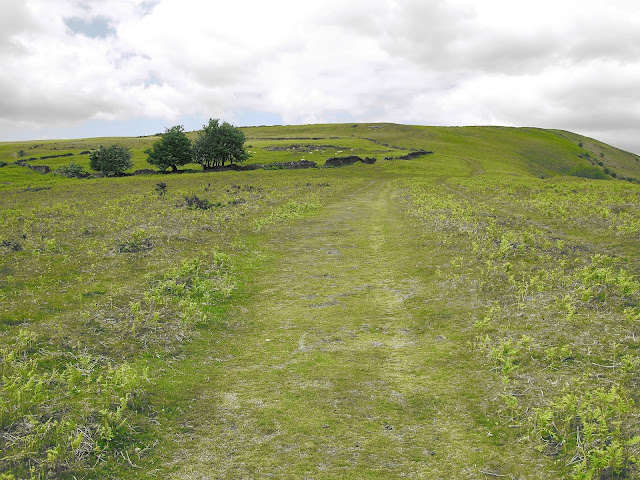
Early Stage of Path

Early Stage of Path


Chepstow Castle,
construction of which began in 1067,
is the oldest surviving post-Roman
stone fortification in the United Kingdom.

Sunday day-walkers as I leave Chepstow


Tinturn Abbey 
(made famous by William Wordsworth's "Lines Composed a Few Miles
Above Tintern Abbey, On Revisiting the Banks of the Wye During a Tour.  July 13, 1798,"
a portion of which is set forth below)


                                                                            . . . I have felt
                                  A presence that disturbs me with the joy
                                  Of elevated thoughts; a sense sublime
                                  Of something far more deeply interfused,
                                  Whose dwelling is the light of setting suns,
                                  And the round ocean and the living air,
                                  And the blue sky, and in the mind of man:
                                  A motion and a spirit, that impels
                                  All thinking things, all objects of all thought, 
                                  And rolls through all things.  Therefore am I still
                                  A lover of the meadows and the woods
                                  And mountains; and of all that we behold
                                  From this green earth; of all the mighty world
                                  Of eye, and ear, — both what they half create,
                                  And what perceive; well pleased to recognize
                                  In nature and language of the sense
                                  The anchor of my purest thoughts, the nurse, 
                                  The guide, the guardian of my heart, and soul
                                  Of all my moral being.


Refined Section of Path Near Tinturn Abbey

Path Along River Wye

Winding Through Wildflower Meadow Along River Wye


Bigsweir Bridge Over the River Wye

Descending Into Village of Redbrook 


Accommodations for Evening in Redbrook


Day 2:  Redbrook to White Castle


Farmer's Track Bordered by Foxglove and Other Wildflowers


Thirteenth Century Gate House Over the River Monnow in Monmouth
(the town in which the future king Henry V was born in 1387)


Sometimes there's a bridge, sometimes not . . .


Sometimes the path is barely visible, such as when crossing a mowed hay field . . .


. . . or crossing a barely trodden wildflower meadow.


A wonderful old church that
always makes tea and biscuits available to walkers


Country lane with Black Mountains in distance
(will soon be walking across that ridge from left to right)


Ruins of White Castle in Monmouthshire, Wales

Day 3:  White Castle to Longtown


Passing through wildflower meadow
(path on extreme right) toward the Black Mountains


 St. Cadoc's Church (13th Century) in LLangattock-Lingoed, 
accross from Old Rectory B&B, where I spent the night


Looking back as I begin walk up toward ridge of mountains

Had lunch on top of this little knoll as I climbed up to the ridge


Note how terrain changes into moorland 
as I continue toward the upper ridges.  Also
note the remains of an ancient circular stone fort in the distance.

With more elevation, one can see the stark 
difference between rather barren vegetation of the higher elevations 
and the rich, fertile fields and pastures in the distant valley.


This view, looking backward from the direction I'm walking, 
gives a sense of how much elevation I've gained since beginning
the day near the distant horizon.


Concrete pillars like this one are called "trig points."  
They were used historically for measurement and navigational 
purposes, and are frequently seen by walkers in the British countryside.


Path Through Moorland on Top Ridge of the Black Mountains

This image shows the variety of terrain in the Black Mountains of Wales — moorland in the foreground, a valley of fertile fields below, and a colorless rocky moonscape in the distance.


In the late afternoon of my first day in the Black Mountains, I took the only 
available path down (left foreground) to search for my pub accommodations in the valley below.

My accommodations in Longtown — The Crown pub and b&b

Day 4:  Longtown to Hay-on-Wye


Climbing back up to the ridge path the next 
morning, I encountered some other fellwalkers out for the day.

After soon reconnecting with the Offa's Dyke Path, 
I came upon this cairn which has been constructed stone by stone by walkers 
passing this way.  The tiny stone on top was my contribution for the day.


A few portions of the ridge path have been reinforced
with stones to protect walkers from sinking in the bogs that permeate these moors.


The higher elevations of the ridge suggest a lunar landscape.


Finally, I begin the long descent from the ridge . . .


. . . encountering wild Welsh ponies along the way . . .


. . . passing through welcoming meadows and woodlands . . . 


 . . . to the charming village of Hay-on-Wye, renowned for it fine small bookshops.


Stay tuned.  More to come on the Offa's Dyke walk.


Wednesday, July 13, 2016

WILLIAM STAFFORD: "THE WAY IT IS"


In her introduction to The Way It Is: New & Selected Poems, a wonderful collection of the poems of William Stafford, poet Naomi Shihab Nye writes:  "In our time there has been no poet who revived hearts and spirits more convincingly that William Stafford.  There has been no one who gave more courage to a journey with words, and silence, and an awakening life."

Having just spent a couple of weeks of reading or re-reading Stafford's work each day, I find myself in complete agreement with Nye's praise.  Stafford's poetry brings both beauty and insight to the ordinary experiences that occur in daily life, and it always reminds us of something ineffably sublime that lies beyond the words of even a poet.

While I have many favorites, the Stafford poem that I keep returning to is the haunting but optimistic title poem, "The Way It Is."  Written just twenty-six days before Stafford died in 1993, it speaks — hopefully, I believe — of the need to remain grounded in something meaningful that will not betray us as we pass through our transitory lives, encountering loss, self-doubt, and suffering along the way.  Every sentence in this poem rings true to me.

                                                  The Way It Is
                                               by William Stafford

                           There's a thread you follow.  It goes among
                           things that change.  But it doesn't change.
                           People wonder about what you are pursuing.
                           You have to explain about the thread.
                           But it is hard for others to see.
                           While you hold it you can't get lost.
                           Tragedies happen; people get hurt
                           or die; and you suffer and get old.
                           Nothing you do can stop time's unfolding.
                           You don't ever let go of the thread.


Thursday, July 7, 2016

MAKING ONE'S LIFE A GREAT POEM

Walt Whitman
1819 - 1892

Three days ago, most of my American compatriots celebrated the Fourth of July with cookouts, fireworks, and other festivities that have little to do with either the history of American independence or the constitutional framework within which we are supposed to govern ourselves and function as a nation.  There were others, however — myself included — who found it difficult to celebrate American ideals during a year in which the members of Congress, most of whom are beholden to the National Rife Association, have not mustered sufficient courage to ban the private sale and purchase of military-grade assault rifles; during a year in which there have already been almost 500 fatal police shootings (many race-based) in this country; during a year in which the presumptive presidential nominee of one of the two major political parties in the United States is widely considered to be a narcissist, a bigot, a xenophobe, a misogynist, a pathological liar, and a man without any visible moral foundation.

This is not the America of our constitutional ideals, and the mere act of paying attention to what is happening — a civic obligation, I would argue — is enough to leave one in a permanent state of depression.  As always, however, something comes alone to remind us of the higher ideals which, historically, have provided this country with optimism, strength, and moral courage when these attributes of character are most needed.  In this case, the redemptive tonic was provided by The Writer's Almanac, which, on the Fourth of July, published an inspirational excerpt from the preface of Walt Whitman's great poetry collection, Leaves of Grass.  No shrinking violet, Whitman tells us what we should do if we want to turn our lives into a great poem. It's good advice for any time, but it holds a special resonance for me at this juncture in my life.  May you, too, find meaning and motivation in these wise words of a true American idealist.

THIS IS WHAT YOU SHALL DO
From Preface to Leaves of Grass 

This is what you shall do:  Love the earth and sun and the animals, despise riches, give alms to every one that asks, stand up for the stupid and crazy, devote your income and labor to others, hate tyrants, argue not concerning God, have patience and indulgence toward the people, take off your hat to nothing known or unknown or to any man or number of men, go freely with powerful uneducated persons and with the young and with the mothers of families, read these leaves in the open air every season of every year of your life, re-examine all you have been told at school or church or in any book, dismiss whatever insults your own soul, and your very flesh shall be a great poem and have the richest fluency not only in its words but in the silent lines of its lips and face and between the lashes of your eyes and in every motion and joint of your body.

Sunday, May 29, 2016

LISTENING TO TREES


Whoever has learned how to listen to trees
no longer wants to be a tree.  He longs to be nothing
except what he is.  That is home.  That is happiness.
Hermann Hesse

We spend our lives among trees — admiring them, climbing them, taking comfort in their shade, eating their fruits, using them for endless commercial purposes.  What we seldom do, however, is pay attention to the ancient wisdom that trees are constantly imparting to us.  Listen to the trees, said the great German writer Hermann Hesse, for they have much to teach us.  

For me, trees have always been the most penetrating preachers.  I revere them when they live in tribes and families, in forests and groves.  And even more I revere them when they stand alone.  They are like lonely persons.  Not like hermits who have stolen away out of some weakness, but like great, solitary men, like Beethoven and Nietzsche.  In their highest boughs the world rustles, their roots rest in infinity; but they do not lose themselves there, they struggle with all the force of their lives for one thing only: to fulfill themselves according to their own laws, to build up their own form, to represent themselves.  Nothing is holier, nothing is more exemplary than a beautiful, strong tree.  When a tree is cut down and reveals its naked death-wound to the sun, one can read its whole history in the luminous, inscribed disk of its trunk: in the rings of its years, its scars, all the struggle, all the suffering, all the sickness, all the happiness and prosperity stand truly written, the narrow years and the luxurious years, the attacks withstood, the storms endured.  And every young farmboy knows that the hardest and noblest wood has the narrowest rings, that high on the mountains and in continuing danger the most indestructible, the strongest, the ideal trees grow.
Trees are sanctuaries.  Whoever knows how to speak to them, whoever knows how to listen to them, can learn the truth.  They do not preach learning and precepts, they preach, undeterred by particulars, the ancient law of life. 
A tree says: A kernel is hidden in me, a spark, a thought, I am life from eternal life.  The attempt and the risk that the eternal mother took with me is unique, unique the form and veins of my skin, unique the smallest play of leaves in my branches and smallest scar on my bark.  I was made to form and reveal the eternal in my smallest special detail.
A tree says:  My strength is trust.  I know nothing about my fathers.  I know nothing about the thousand children that every year spring out of me.  I live out the secret of my seed to the very end, and I care for nothing else.  I trust that God is in me.  I trust that my labor is holy.  Out of this trust I live.
When we are stricken and cannot bear our lives any longer, then a tree has something to say to us: Be still! Be still! Look at me! Life is not easy, life is not difficult.  Those are childish thoughts.  Let God speak within you, and your thoughts will grow silent.  You are anxious because your path leads away from mother and home.  But every step and every day lead you back again to the mother.  Home is neither here nor there.  Home is within you, or home is nowhere at all.
A longing to wander tears my heart when I hear trees rustling in the wind at evening.  If one listens to them silently for a long time, this longing reveals its kernel, its meaning.  It is not so much a matter of escaping from one's suffering, though it may seem to be so.  It is a longing for home, for a memory of the mother, for new metaphors for life.  It leads home.  Every path leads homeward, every step is birth, every step is death, every grave is mother.
So the tree rustles in the evening, when we stand uneasy before our own childish thoughts: Trees have long thoughts, long-breathing and restful, just as they have longer live than ours.  They are wiser than we are, as long as we do not listen to them.  But when we have learned how to listen to trees, then the brevity and the quickness and  the childlike hastiness of our thoughts achieve an incomparable joy.  Whoever has learned how to listen to trees no longer wants to be a tree.  He wants to be nothing except what he is.  That is home.  That is happiness. 
 From Bäume: Betrachtungen und Gedichte
(Trees: Reflections and Poems)
by
Hermann Hesse 

Friday, April 29, 2016

CLOSE ENCOUNTERS WITH BARRED OWLS

Barred Owl

We are all visionaries,
and what we see is our soul in things.

Henri Amiel

In her poem "White Owl Flies Into and Out of the Field," Mary Oliver described an owl she once observed as "an angel, or a Buddha with wings."  This imagery has frequently resurfaced in my mind during the past week as I have studied the daily habits of the male barred owl pictured above, his mate, and the two young owlets that were born to the couple just a few weeks ago, and who are now in their fledgling phase.

On the day after first sighting the large male, I discovered him again, sitting on the limb of a tree within 25 feet of our front porch.  As soon as I peered through the viewfinder of my camera, a young owlet peeped out of a rotten cavity in an adjacent tree, informing me for the first time that this was a springtime family affair.  A couple of days later, two owlets emerged from the top of the rotten tree and eventually developed the courage to jump to a branch.  Since then, they have been struggling to understand their bodies, especially the large wings, while simultaneously trying to survive aggressive crow attacks and the piercing eyes of the red-shouldered hawks which are also abundant in these woods.  Through it all, the large male has been truly amazing, providing the young owlets with broad latitude to fail as they experiment with life, yet always ready to swoop down when necessary to protect them from predators.

Set forth below are some of the images I have taken of the barred owls, especially the young owlets.  Enjoy.

With this post, I hope to begin posting on a more regular basis.  It's been thirteen months since my last post, a sabbatical that happened without design as I simply tried to spend more time in the moment — and in movement.


Sunday, March 22, 2015

HOPE FOR THE PAST

Robert Frost
(1874 - 1963)
Photo by Walter Albertin

The concept of hope is usually reserved for the future.  As Robert Frost and David Ray's poem remind us, however, it may be that a more pressing question is whether there is hope for one's past — all of the actions, decisions, and indecisions that undergird what one has become.

                                                 Thanks, Robert Frost
                                                         by David Ray

                                Do you have hope for the future?
                                someone asked Robert Frost, toward the end.
                                Yes, and even for the past, he replied,
                                that it will turn out to have been all right
                                for what it was, something we can accept,
                                mistakes made by the selves we had to be,
                                not able to be, perhaps, what we wished,
                                or what looking back half the time it seems
                                we could so easily have been, or ought . . .
                                The future, yes, and even for the past,
                                that it will become something we can bear.
                                And I too, and my children, so I hope,
                                will recall as not too heavy the tug
                                of those albatrosses I sadly placed
                                upon their tender necks.  Hope for the past,
                                yes, old Frost, your words provide that courage,
                                and it brings strange peace that itself passes
                                into past, easier to bear because
                                you said it, rather casually, as snow
                                went on falling in Vermont years ago.

Credit:  David Ray's poem, "Thanks, Robert Frost," is published in Music of Time: Selected and New Poems (The Blackwater Press, 2006).  Thanks also to Parker J. Palmer's column, Meaning Changes As Life Unfolds, published March 18, 2015, on Krista Tippett's excellent site, "On Being".


Wednesday, February 25, 2015

WELCOMING ALL GUESTS


                                               THE GUEST HOUSE
                                                          By Rumi
                                             (Translation by Coleman Barks)

                                     This being human is a guest house.

                                     Every morning a new arrival.

                                     A joy, a depression, a meanness,

                                     some momentary awareness comes
                                     as an unexpected visitor.

                                     Welcome and entertain them all!

                                     Even if they're a crowd of sorrows,
                                     who violently sweep your house
                                     empty of its furniture,
                                     still, treat each guest honorably.
                                     He may be clearing you out
                                     for some new delight.

                                     The dark thought, the shame, the malice,

                                     meet them at the door laughing, 
                                     and invite them in.

                                     Be grateful for whoever comes,

                                     because each has been sent
                                     as a guide from beyond.