Sunday, February 26, 2012

WORD VERIFICATION PROBLEMS

As most of you know, Blogger's new word verification format has made it increasingly difficult to comment on postings.  The two verification words are often unreadable, and multiple attempts are frequently required by those seeking to comment.  As a result, some bloggers have disabled the word verification requirement on their blogs, and others have said that they will no longer comment on blogs requiring word verification.

Several days ago, in an effort to make things a bit easier for those commenting on my blog, I disabled the word verification requirement.  Unfortunately, the results have not been good.  I am receiving 3-5 comments per day from anonymous people and spammers.  Many of the undesirable comments are made on articles that were published many months ago.  The comments appear to be computer-generated; indeed, I have sometimes received the same irrelevant comment (something to do with Syria) posted on different blogs.

Under the circumstances, I have enabled word verification once again.  I apologize for any inconvenience this causes to anyone, but I think the preferable course for me is to live with the situation until Blogger comes up with a solution.  Hopefully, that will happen soon.  Based upon my research, it appears that the entire blogging world is up arms about the new word verification format.

As always, I appreciate the comments of those who read these postings.

George

Tuesday, February 14, 2012

BLESSINGS


I recently heard someone speak rather derisively of people who express gratitude for their blessings.  The thrust of the comment was that the very idea of "blessings" is an archaic, theological concept that has no place in the post-Enlightenment world.

While I have a wide tolerance for various theological points of view, I found myself somewhat puzzled by this comment because it seems to me that one can feel genuinely blessed and grateful without having a hardened position about the source of the blessings.  Isn't life itself a blessing, life with all of its infinite possibilities?  And what of the world of our inheritance—not the inevitable pain, frustration, and suffering—but love, beauty, music, art, the opportunity to become one of the co-creators of the world?  Are not these abiding blessings?  I believe they are, and I find that my heart sings in agreement when I read the following passage from John O'Donohue's fine essay, "To Retrieve the Lost Art of Blessing," which is found in O'Donohue's book, To Bless the Space Between Us.

There is a kindness that dwells deep down in things: it presides everywhere, often in the places we least expect.  The world can be harsh and negative, but if we remain generous and patient, kindness inevitably reveals itself.  Something deep in the human soul seems to depend on the presence of kindness; something instinctive in us expects it, and once we sense it we are able to trust and open ourselves . . . 
Despite all the darkness, human hope is based on the instinct that at the deepest level of reality some intimate kindness holds sway.  This is the heart of blessing.  To believe in blessing is to believe that our being here, our very presence in the world, is itself the first gift, the primal blessing. As Rilke says: Heir zu sein ist so viel—to be here is immense.  Nowhere does the silence of the infinite lean so intensely as around the form of a newly born infant.  Once we arrive, we enter into the inheritance of everything that has preceded us; we become heirs to the world.  To be born is to be chosen.  To be created and come to birth is to be blessed. Some primal kindness chose us and brought us through the forest of dreaming until we could emerge into the clearance of individuality, with a path of life opening before us through the world.
The beginning often holds the clue to everything that follows.  Given the nature of our beginning, it is no wonder that our hearts are imbued with longing for beauty, meaning, order, creativity, compassion, and love.  We approach the world with this roster of longings and expect that in some way the world will respond and confirm our desire.  Our longing knows it cannot force the fulfillment of its desire; yet it does instinctively expect that primal benevolence to respond to it.  This is the threshold where blessing comes alive. 

Einstein once suggested that the most important question a person can ask is whether the universe is a friendly place.  The answer, I suppose, would probably vary from person to person, depending on whether one is an optimist, a pessimist, or a downright cynic.  At the very least, however, I feel deeply that our lives enjoy the blessings of what John O'Donohue refers to as "primal kindness" or "primal benevolence."  Each person is free, of course, to provide his or her own theological tag to that kindness and benevolence, but, as always, it's not the label of a thing, but rather its essence, that befriends the questing heart.  We are the most improbable of creatures living on the most improbable of planets, and if we have nothing else, we always have the opportunity to transform ourselves and our world. That, for me, will always be a blessing worthy of my highest gratitude.

Monday, January 30, 2012

SMALL POEMS, BIG IDEAS


Robert Frost famously wrote that "happiness makes up in height for what it lacks in length."  The same might also be said for poetry.  In my view, some of the shortest poems have the deepest meanings.

Set forth below are a few of the small poems that are included in the poetry anthologies I've been reading this winter.  If you have a favorite small poem and would like to include it in your comments, please feel free to do so.

                                            THE RED WHEELBARROW
                                                 William Carlos Williams


                                                      so much depends
                                                      upon


                                                      a red wheel 
                                                      barrow


                                                      glazed with rain
                                                      water


                                                      beside the white
                                                      chickens


                                                 THE SECRET SITS
                                                        Robert Frost
                                                         
                                   We dance round in a ring and suppose,
                                   But the Secret sits in the middle and knows.


                                                          COMMENT
                                                        Dorothy Parker


                                     Oh, life is a glorious cycle of song,
                                     A medley of extemporanea;
                                     And love is a thing that can never go wrong;
                                     And I am Marie of Roumania.


                                      TODAY, LIKE EVERY OTHER DAY
                                                                 Rumi


                                  Today, like every other day, we wake up empty
                                  and frightened.  Don't open the door to the study
                                  and begin reading.  Take down a musical instrument.


                                  Let the beauty we love be what we do.
                                  There are hundreds of ways to kneel and kiss the ground.


                                                LOVING THE RITUALS
                                               Palladus (4th Century A.D.)


                                      Loving the rituals that keep men close,
                                      Nature created means for friends apart;


                                      pen, paper, ink, the alphabet,
                                      signs for the distant and disconsolate heart.


                                                               WITNESS
                                                           Denise Levertov


                                                   Sometimes the mountain
                                                   is hidden from me in veils
                                                   of cloud, sometimes
                                                   I am hidden from the mountain
                                                   in veils of inattention, apathy, fatigue,
                                                   when I forget or refuse to go
                                                   down to the shore or a few yards
                                                   up the road, on a clear day,
                                                   to reconfirm
                                                   that witnessing presence.


                                                           AUTO MIRROR
                                                           Adam Zagajewski
                                    (translation by Czelaw Milosz and Robert Hass)


                                               In the rear-view mirror suddenly
                                               I saw the bulk of the Beauvais Cathedral; 
                                               great things dwell in small ones
                                               for a moment.


                                                        A LONG LIFETIME
                                                           Kenneth Rexroth


                                                        A long lifetime
                                                        Peoples and places
                                                        And the crisis of mankind—
                                                        What survives is the crystal—
                                                        Infinitely small—
                                                        Infinitely large—


                                                        MY FIFTIETH YEAR
                                                         William Butler Yeats


                                               My fiftieth year had come and gone,
                                               I sat, a solitary man,
                                               In a crowded London shop,
                                               An open book and empty cup
                                               On a marble table-top.


                                               While on the shop and the street I gazed
                                               My body of a sudden blazed;
                                               And twenty minutes more or less
                                               It seemed, so great my happiness,
                                               That I was blessed and could bless.

Friday, January 27, 2012

TRUE SELF AS NO SELF

Chuang Tzu

Thomas Merton

As we can see from their apparel, both of these men were spiritual contemplatives. The first, Chuang Tzu, lived in China more than two thousand years ago and is considered to be the greatest Taoist writer whose existence can be verified (the existence of Lao Tzu, the presumed author of the Tao Te Ching, has not been verified).  The second, Thomas Merton, was a 20th century Trappist monk who wrote extensively on matters of spirituality, comparative religion, and social justice.

In the later years of his life, Merton became increasingly ecumenical in his spiritual philosophy.  During this period, he studied Chuang Tzu extensively, and he eventually published a book of poems—The Way of Chuang Tzu—which he regarded as interpretive readings of the classic works the Taoist master. Anticipating criticism from those Christians who are more exclusive than inclusive in their world view, Merton introduced the book by declaring:
If St. Augustine could read Plotinus, if St. Thomas could read Aristotle and Averroes (both of them certainly a long way further from Christianity than Chuang Tzu ever was!), and if Teilhard de Chardin could make copious use of Marx and Engels in his synthesis, I think I may be pardoned for consorting with a Chinese recluse who shares the climate and peace of my own kind of solitude, and who is my own kind of person.
Elsewhere in the introduction, Merton shows us why he related so much to Chuang Tzu:
[T]he whole teaching, the 'way' contained in these anecdotes, poems, and meditations, is characteristic of a certain mentality found everywhere in the world, a certain taste for simplicity, for humility, self-effacement, silence, and in general a refusal to take seriously the aggressivity, the ambition, the push, and the self-importance which one must display in order to get along in society.  This other is a 'way' that prefers not to get anywhere in the world, or even in the field of some supposed spiritual attainment.

One of Merton's interpretive poems—titled The Man of the Tao—is set forth below. I've chosen this poem because it seems to incorporate two spiritual themes that are woven deeply into both eastern and western spiritual traditions.  The first theme, which is embodied in the title of this post, is that the conditioned, egotistical self is a false self that must ultimately be put aside if we are to become—and fully experience—our authentic selves.  The second theme, which to some extent is premised on the first, is that we must be wary of spiritual hubris.  According to Merton's interpretation of Chuang Tzu, the truly spiritual person "does not take pride in himself [or herself] on walking alone."  Nor does he or she judge those who "follow the crowd."


THE MAN OF TAO

                                               The man in whom Tao
                                               Acts without impediment
                                               Harms no other being
                                               By his actions
                                               Yet he does not know himself
                                               To be "kind," to be "gentle."

                                               The man in whom Tao
                                               Acts without impediment
                                               Does not bother with his own interests
                                               And does not despise
                                               Others who do.
                                               He does not struggle to make money
                                               And does not make a virtue of poverty.
                                               He goes his way
                                               Without relying on others
                                               And does not pride himself
                                               On walking alone.
                                               While he does not follow the crowd
                                               He won't complain of those who do.
                                               Rank and reward
                                               Make no appeal to him;
                                               Disgrace and shame 
                                               Do not deter him.
                                               He is not always looking
                                               For right and wrong
                                               Always deciding "Yes" or "no."
                                               The ancients said, therefore:

                                               "The man of Tao
                                               Remains unknown
                                               Perfect Virtue
                                               Produces nothing
                                               'No-self'
                                               Is 'True-Self.'
                                               And the greatest man
                                               Is Nobody."

Merton worked tirelessly to bridge the spiritual traditions that often separate peoples and cultures.  He died as a committed Christian monk, but he is remembered as someone whose ideals transcended his own personal identity.  Speaking at Merton's funeral, the Dalai Lama said, "I always consider myself as one of his Buddhist brothers."  In a similar vein, the great Buddhist teacher Thich Nhat Hanh has said that Merton was "an artist, a Zen."

Tuesday, January 24, 2012

MEDITATIONS ON NATURE (II): THOREAU

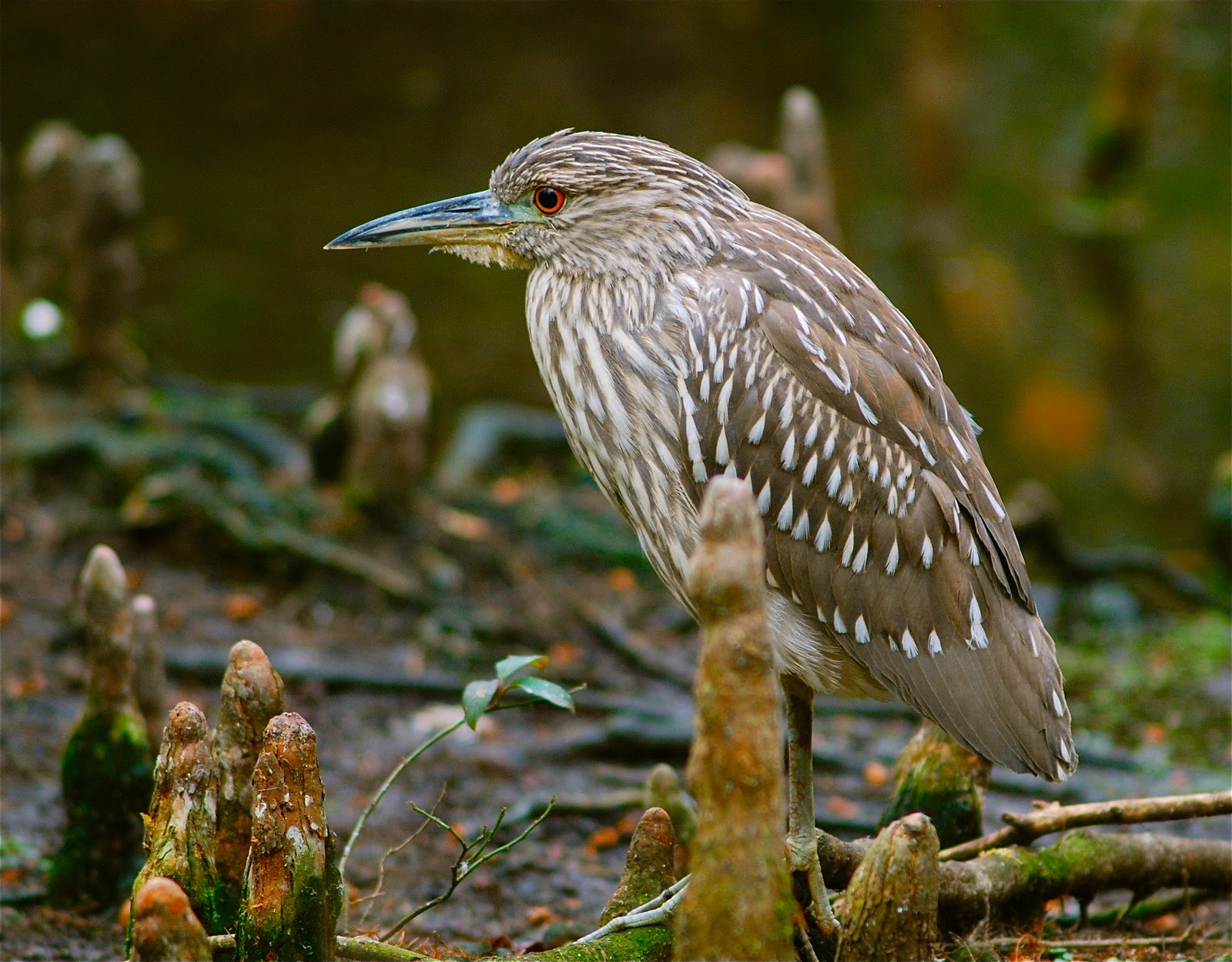
Black-Crowned Night Heron

I love nature partly because  she is not man, but a retreat from him.  None of his institutions control or pervade her.  There a different kind of right prevails.  In her midst I can be glad with an entire gladness.  If this world was all man I could not stretch myself—I should lose all hope.  He is constraint; she is freedom to me.  He makes me wish for another world; she makes me content with this.
Thoreau's Journal (January 3, 1853)


Great White Egret
There can be no very black melancholy to him who lives in the midst of Nature and has his senses still.
Thoreau, Walden


Great Blue Heron
We must go out and re-ally ourselves to Nature every day.  We must take root, send out some little fibre at least, even every winter day.  I am sensible that I am imbibing health when I open my mouth to the wind.
Thoreau, Journal (December 29, 1856) 


White Ibis
How important is a constant intercourse with nature and the contemplation of natural phenomenon to the preservation of moral & and intellectual health.
Thoreau's Journal (May 6, 1851)


Black-Crowned Night Heron (Immature)
We need the tonic of wildness—to wade sometimes in marshes where bittern and meadow-hen lurk, and hear the booming of the snipe; to smell the whispering sedge where only some wilder and more solitary fowl builds her nest, and mink crawls with its belly close to the ground.

Thoreau, Walden


Brown Pelican
For my part, I feel, that with regard to Nature, I live a sort of border life, on the confines of the world, into which I make occasional and transient forays only, and my patriotism and allegiance to the state into whose territories I seem to retreat are those of a moss-trooper.  Unto a life which I call natural I would gladly follow even a will o' the wisp through the bogs and sloughs unimaginable.
Thoreau, "Walking" in Excursions 


Snowy Egret

I have a room all to myself; it is Nature.

Thoreau's Journal (January 3, 1853)


Black-Crowned Night Heron

The true harvest of my daily life is somewhat as intangible and indescribable as the tints of morning or evening.  It is a little star-dust caught, a segment of the rainbow I have clutched.
Thoreau, Walden

Friday, January 20, 2012

TO LOVE DIFFERENTLY

A Pair of Lovers, by Van Gogh

Love is the only sane and satisfactory answer to the problem of human existence.
Eric Fromm


This posting has its genesis in a fine poem—To Have Without Holding—by poet and novelist Marge Piercy.  Since reading the poem a few days ago, I have continued to be haunted by the first line: "Learning to love differently is hard."

From my perspective, this poem touches upon something profound, specifically, the way that life experiences shape our evolving approaches to love.  One of the charming conceits of youth is the romantic ideal that each of us will eventually meet someone and "fall" effortlessly into a state of perennial bliss—a sort of nirvana in which the relationship is protected from the vicissitudes of life.  Romantic ideals, however, always have a way of colliding with reality, and when that occurs, we usually have only two choices.  We can either become disappointed and cynical, or we can begin to reevaluate and reshape our romantic ideals.  We can, as Piercy suggests in the first line of her poem, learn to "love differently."  We can even learn to "love with the doors banging on their hinges, the cupboard unlocked, the wind roaring and whimpering in the rooms . . ."  And if we do, if we are willing to give up the clutch-hold on our youthful romantic ideals, we may come to find the very thing we have been looking for all along, a deep love that is rich and enduring, one that is more than adequate to withstand the conflicts, disappointments, and frustrations that await every journey. 

Enough of what I think.  What do you think?  Perhaps you will find something in Piercy's poem that resonates with your own life.

TO HAVE WITHOUT HOLDING
by Marge Piercy

                                      Learning to love differently is hard, 
                                      love with the hands wide open, love
                                      with the doors banging on their hinges,
                                      the cupboard unlocked, the wind
                                      roaring and whimpering in the rooms
                                      rustling the sheets and snapping the blinds
                                      that thwack like rubber bands
                                      in an open palm.

                                      It hurts to love wide open
                                      stretching the muscles that feel
                                      as if they are made of wet plaster,
                                      then of blunt knives, then
                                      of sharp knives.

                                      It hurts to thwart the reflexes
                                      of grab, of clutch; to love and let
                                      go again and again.  It pesters to remember
                                      the lover who is not in the bed,
                                      to hold back what is owed to the work
                                      that gutters like a candle in a cave
                                      without air, to love consciously,
                                      conscientiously, concretely, constructively.

                                      I can't do it, you say it's killing
                                      me, but you thrive, you glow
                                      on the street like a neon raspberry,
                                      you float and sail, a helium balloon
                                      bright bachelor's button blue and bobbing
                                      on the cold and hot winds of our breath,
                                      as we make and unmake in passionate
                                      diastole and systole the rhythm
                                      of our unbound bonding, to have
                                      and not to hold, to love
                                      with minimized malice, hunger
                                      and anger moment by moment balanced.

Lest there be any doubt, I do not stand pure in this arena.  Quixotically, I have broken many lances in the windmills of youthful romantic ideals.  With every passing year, however, I have tried to reshape those ideals to account for the unpredictability of human life—my life and the lives of others—and while much work remains to be done, I feel, perhaps for the first time in many decades, that I am learning "to love and let go again and again."  I am learning to love differently.

Monday, January 16, 2012

WHY POETRY?


It is difficult to get the news from poems,
yet men die miserably every day for the lack of what is found there.

William Carlos Williams

One of the great joys of blogging is the opportunity to interact with other people who love poetry, many of whom are poets themselves.  It's a social pleasure that I rarely encounter in my day-to-day life offline.  Perhaps it's an unjustifiable cultural bias of mine, but most of my fellow Americans seem to head for the exits at the mere mention of poetry.

Thanks to an extraordinary teacher I had in high school, poetry has been a constant companion of mine for more than five decades.  When I have felt friendless and alone, poetry has offered its friendship and reminded me that I am not the first to undertake this uncertain voyage; nor shall I be the last.  When I have felt bewildered and lost, poetry has provided a bright lodestar against which I could take my bearings and find my way.  And when I have found myself stymied over the inability to understand the true essence of love—this pervasive ideal that seems impossible to define with any precision—poetry has always revealed something so beautiful, so simple and unexpected, that I could say at last, "yes, this is what love feels like." 

I'm digressing a bit here, for the main point of this post is to share some wonderful observations I have come across recently about the unique importance of poetry in our lives.  The first quote comes from  V.V. Raman, who is a theoretical physicist, rather than a poet himself.  All of the other quotes are from former poets laureate of the United States, and are found in The Poets Laureate Anthology (2010).

V.V. Raman
(From Interview with Krista Tippett in Einstein's God)
[P]oetry is what gives meaning to existence.  Not fact and figures and charts, but poetry. Poetry is essentially a really sophisticated way of experiencing the world.  And it is much more than mere words and stories.  Poetry is to the human condition what the telescope and the microscope are to the scientist.

W.S. Merwin
Prose is about something, but poetry is about what can't be said.  Why do people turn to poetry when all of a sudden the Twin Towers get hit, or when their marriage breaks up, or when the person they love most in the world drops dead in the same room?  Because they can't say it.  They can't say it at all, and they want something that addresses what can't be said.

Kay Ryan

It's poetry's uselessness that excites me . . . Prose is practical language. Conversation is practical language.  Let them handle the usefulness jobs. But of course, poetry has its balms.  It makes us feel less lonely by one.  It makes us have more room inside ourselves.

Billy Collins

Time is not just money—sorry, Ben Franklin—time is a way of telling us if we are moving at the right pace through the life that has been given us. One of the most basic pleasures of poetry is the way it slows us down. The intentionality of its language gives us pause.  Its formal arrangement checks our haste.

Stanley Kunitz
If we want to know what it felt like to be alive at any given moment in the long odyssey of the race, it is to poetry we must turn.  The moment is dear to us, precisely because it is so fugitive, and it is somewhat of a paradox that poets should spend a lifetime hunting for the magic that will make the moment stay.  Art is the chalice into which we pour the wine of transcendence.  What is imagination but a reflection of our yearning to belong to eternity as well as to time.

Robert Fitzgerald 
Our lifetimes have seen the opening of abysses before which the mind quails.  But it seems to me there are few things everyone can humbly try to hold onto: love and mercy (and humor) in everyday living; the quest for exact truth in language and affairs of the intellect; self-recollection or prayer; and the peace, the composed energy of art.
                                         
Photos:  Photo of V.V. Raman downloaded from Wikipedia.  All other photos were downloaded from the website of the Poet Laureates of the United States.