Friday, September 2, 2011

WALKING THE HADRIAN'S WALL PATH: Day 3 — Wall to Once Brewed

Robert and Dominic (orange shell) Walking on Top of a Turf-covered Portion of the Wall
From Wall I'd been shadowing a figure in a blue rain shell and red cap for about half an hour.  I was pretty sure it was him.  We crossed the river Tyne at Chollerford separated by only a few minutes . . . 
                                                         The Solitary Walker
                                                         "Bloggers are Real People Too"
                                                          Post of August 29, 2011

On the morning of my third day, while checking out of the Hadrian Hotel in Wall, I briefly glanced at another guest whose face vaguely reminded me of the tiny photo of Robert that appears in the profile section of The Solitary Walker.  Quickly, however, I dismissed any thought that this might actually be The Solitary Walker, because Robert and I had specifically agreed to meet the following afternoon in the village of Gilsland.

Leaving the hotel, I walked through a light rain toward Chollerford, detouring along the way to explore another fine section of the wall and the foundation of one of the old turrets. . . 


In Chollerford, I crossed a lovely old bridge over the River Tyne . . . 


and then proceeded to Chesters Fort, which is considered to be the best visible remains of a Roman cavalry fort in Britain.  Arriving a few minutes before the gates opened, I walked up several steps to the museum entrance and began chatting with a couple of German walkers.  Sensing the presence of someone behind me, I stepped back ever so slightly, and in doing so, I slipped off the edge of the elevated platform and began tumbling down the steps.  In an effort to avoid a small disaster — and obviously inspired by some of the free-style skiing maneuvers I have seen in the winter Olympics — I executed what I would call a "half twist with poles," which, fortunately, allowed me to remain upright and uninjured, though I almost collided with a stranger in a blue rain shell similar to my own.

As soon as I regained my composure, the stranger made a comment about how amazing it was that two walkers in similar rain gear had so much in common.  As I hesitated, trying to come up with an appropriate response, the stranger asked if I was doing the entire Hadrian's Wall walk alone, whereupon I replied that I would be joined by a good friend the next day.  And then came the stranger's zinger: "Would that friend happen to be the solitary walker?"  Well, as they say, folks, the rest is history.  Robert and I began talking as if we had known each other for our entire lives, and we continued to talk for the next four days as we hiked through some of the most beautiful and historically interesting countryside that England has to offer.

Robert — The Solitary Walker

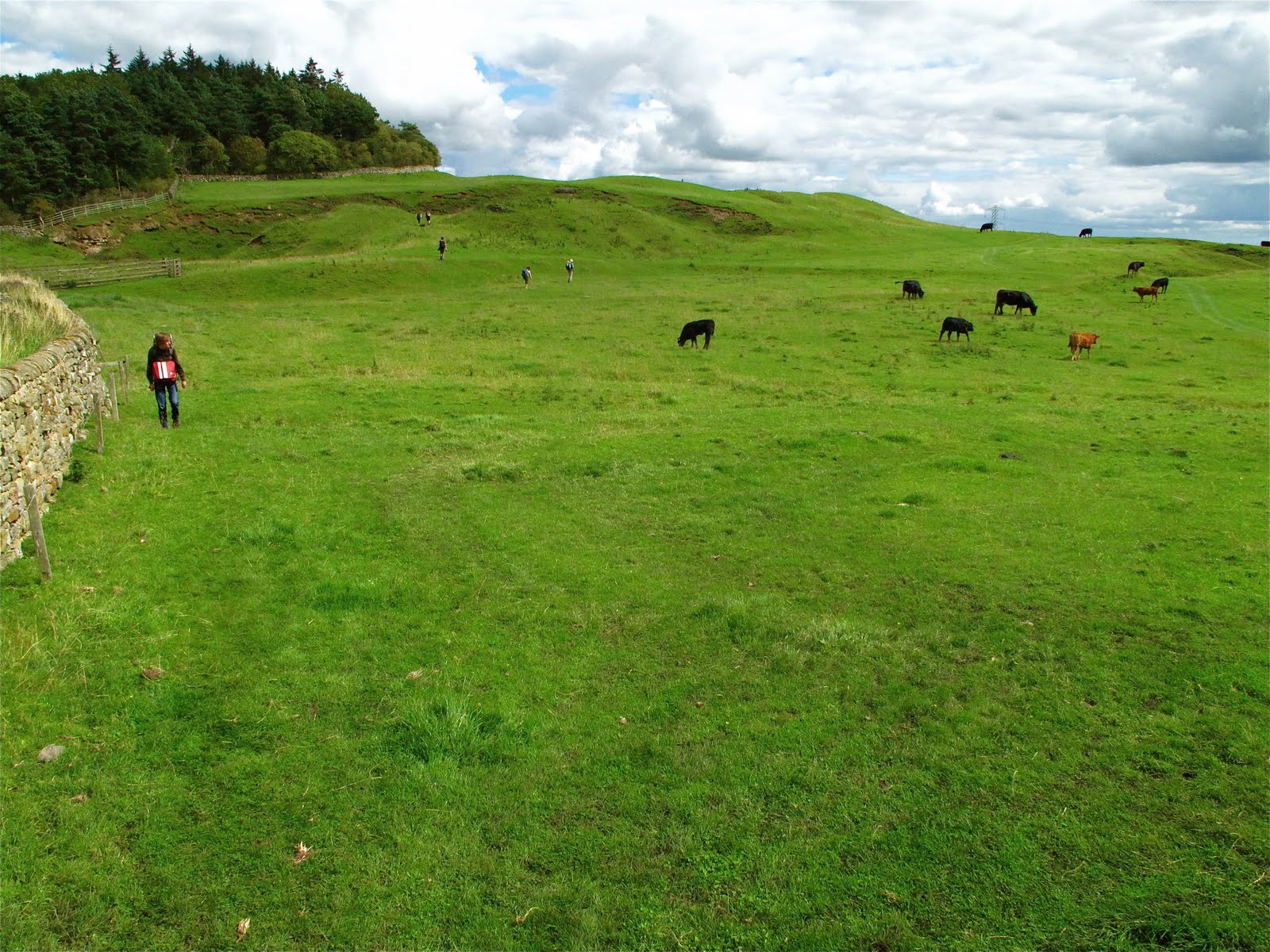
Some of the other sights seen on this day's walk are set forth below. With nothing more than captions, I will let the photos speak for themselves.

Ruins of Chesters Fort

A Portion of the Hadrian's Wall to Left of the Path

A Farmstead Near the Wall


Ruins of a Mithras Temple
(Mithras was the Latin name of the Persian god, Mithra, and Mithraism,
a religion which emphasized truth, honor, bravery, and discipline,
was the unofficial faith of the Roman soldiers)

Close-up of Inside the Mithras Temple
  

The Solitary Walker and Other Walkers Discuss a Navigational Issue
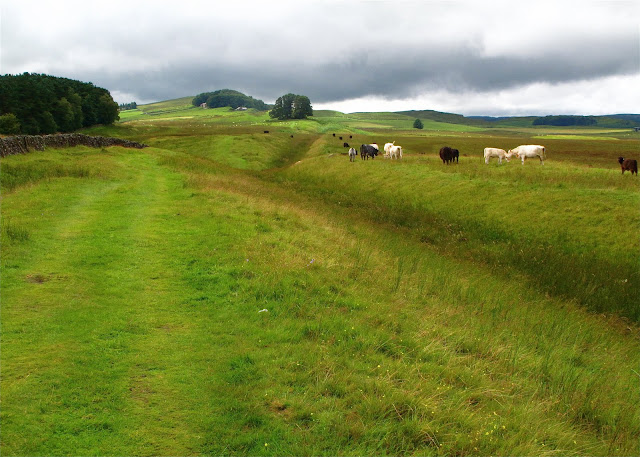

  A Portion of the Path on Top of the Turf-Covered Wall

Foundation of Old Turret

Path Along the Wall


Beautiful Views of the Countryside From Higher Elevations

Distant View of Wall Snaking Through the Hills


Other Walkers on the Path

Ruins of the Roman Fort at Housesteads


Housesteads

Housesteads

Housesteads — Ruins of the Granary

Housesteads


Robert Walking Up the Whin Sill Ridge


A Stone Structure Near Sycamore Gap

Robert Ascending From Sycamore Gap

Sycamore Gap (behind Robert) is named after the large, solitary sycamore that grows in the dip.  According to Henry Steadman, author of Hadrian's Wall Path, "the sycamore is something of a local celebrity, having appeared in the film Robin Hood alongside Kevin Costner (where, despite the distinct disadvantage of being a tree, it still managed to appear less wooden than its co-star.)"


Another Milecastle


The Path Took Us Toward the Village of Once Brewed . . . 

. . . Before a Final Descent and a Short Walk to the Village


Next Post:  Days 4 and 5 — Once Brewed to Newtown

Monday, August 29, 2011

WALKING THE HADRIAN'S WALL PATH: Days 1 and 2 — Wallsend to Wall


Milecastle 39 of Hadrian's Wall
Hadrian's Wall formed the north-west frontier of the Roman empire for most of the period AD122-410.  The empire's frontiers extended over 5,000 km from the Atlantic coast of Britain through Europe, the Middle East and across North Africa to the Atlantic.
The site's outstanding universal value to humanity is recognized under the World Heritage Convention, 1972.
                                              Inscription on UNESCO Plaque at Segedunum 


Eight days ago, I completed my 85-mile walk of the Hadrian's Wall Path, which stretches westward from Wallsend (just outside Newcastle on Tyne) to Bowness on Solway.  Now part of the United Kingdom's incomparable national trail system, the path follows the ruins of the magnificent wall constructed by the Romans between AD 122 and 128 under the direction and guidance of Emperor Hadrian, who is remembered historically as one of "the five good emperors."

The Romans occupied Britannia in AD 43 and spent many years thereafter trying to subjugate the local tribes.  On the whole, they were eminently successful; indeed, to some extent, many of the southern tribes eventually grew comfortable with the civil order and new infrastructure that came with Roman life.  The northern tribes, however, known collectively as the Caledones and living in the area that is now Scotland, remained steadfastly recalcitrant and continued to resist Roman occupation at every opportunity.  At the same time, mounting obligations in other parts of the Roman Empire were placing new burdens on both the treasury and the manpower of the empire.  Thus, rather than remain in perennial conflict with the Caledones, the Romans decided to formally establish a northern frontier to their empire and to fortify that boundary as a means of separating the "lawless" northern tribes from the conquered and "law-abiding" southern tribes.

It was against this backdrop that Hadrian ordered the construction of the wall in  AD 122. Much of the wall has been destroyed over the centuries by subsequent military conflicts, vandalism, scavenging, and weather.  What remains, however, is magnificent, which is why UNESCO, in 1987, added the wall to its list of World Heritage Sites, placing the wall in the company of Petra, Angkor Wat, Machu Picchu, the Taj Mahal, and the Great Wall of China.  Moreover, as indicated above, a walking path parallel to the wall was formally established and made part of the UK's national trail network in 2003.

I was honored to be joined on the walk by my two great friends — Robert, author of The Solitary Walker, who joined me for four days of the walk, and Dominic, author of Made Out of Words, who joined us for a couple of those days.  Meeting these guys and enjoying their fine, cheerful, and edifying company was, without question, the highlight of the entire trip for me.  For what it's worth, there was not a scintilla of difference between the friends I encountered personally and the initial impressions I had drawn of them from their respective blogs.  Authentic, intelligent, adventurous, morally courageous, and good humored — these are the words that best describe the two guys who tramped with me through the best sections of the Hadrian's Wall path.

More about Robert and Dominic to come, so let's begin. 

Day 1:  Wallsend to Wylam

The path began inauspiciously at Wallsend near the foundation (photo below) of the ancient Roman fort of Segedunum, which is located in a largely industrial area.


Soon after leaving Segedunnum, however, the path took on its own kind of beauty, with magnificent patches of rosebay willowherb juxtaposed against the blue fences that offered visual protection from some of the modern developments.


The initial four or five miles of the path is an asphalt walking/cycling track that runs alongside the River Tyne.  At one point, however, the path diverted through some lovely parkland . . .


. . . before returning to the asphalt track along the river.  In the distance, I could see the city of Newcastle . . .


. . . which has some very interesting bridges, including the Millennium Bridge (below), also known as the "winking eye" or "blinking eye" bridge.  As one can see from the darkness of the next photo, however, the weather was taking a turn for the worse, so I pressed on, eager to reach the green, softer footing of the English countryside.


After leaving Newcastle, I reached the pleasant surroundings of the Tyne Riverside Country Park and and followed a riparian path that catered to equestrians and cyclists, as well as walkers. 


After a few miles, the path turned away from the river, proceeded through some pleasant communities . . .


. . . and turned down the Wylam Waggonway. . . 


. . . past the childhood cottage of George Stephenson, inventor of first steam locomotive for railroads . . .


. . . to the village of Wylam, where I spent the first evening.

Day 2:  Wylam to Wall

After a brief walk to from Wylam to Heddon-on-the-Wall, I discovered the first significant portion of Hadrian's Wall.  


The path then paralleled a highway that was built upon the wall many years ago. The views were lovely, however, often giving me a sense of walking up into the clouds.


Being a national trail, the path was well marked.  When in doubt on a national trail, one need only follow the white acorn, which is always posted on signposts, stiles, kissing gates, and other places along the path.


After crossing the road in the above photo, I continued westward past magnificent wheat and barley fields, all crowned with magical clouds.


Passing through small villages, I discovered lovely old church doors . . . 


. . . colorful barns . . . 


. . . and stunning landscapes . . .


As I moved westward, the path was bracketed by endless bouquets of wildflowers on the left and a stone wall on the right . . . 


. . . eventually leading me to cross the road, walk through a pasture of grazing cows . . . 


. . . cross over a stile (note the white acorn reminder of a national trail) . . .


. . . and discover a wonderful new section of the wall.


A few miles later, I arrived at the village of Wall, where I spent my second evening of the walk at the Hadrian Hotel.  Little did I know that another guest in the hotel that night was the mysterious Solitary Walker . . .

Stay tuned.  The scenery and the stories get better in the next post.

Friday, July 8, 2011

REMEMBERING A DISTANT FRIEND


In my last posting, I told the story of two encounters that my college roommate, Anthony, and I had fifty years ago with the novelist William Faulkner.  Little did I know when I wrote that post that Anthony was in the last days of his battle with mantle cell lymphoma, a cancer that he had been fighting for more than a decade. A few days ago, I learned that just eight days after my post, Anthony finally succumbed to the disease and died in Buenos Aires, the city in which he had chosen to spend his final days.

Since learning of Anthony's death, I have felt the need to offer a small tribute to his life.  It's been a difficult task, however, because this was not one of those friendships that endured through thick and thin.  While our lives intersected for a few good years during our youth, we eventually followed very different paths and lifestyles, and, increasingly with each passing year, we had less and less in common.  One thing that remained, however, was a mutual love of language and the myriad ways in which words can be crafted and spoken to lift and sustain the human spirit.  Words, words, words — their beauty, their magic, and their undeniable power — a power that drove me to become a lawyer and Anthony to become an actor. 

Anthony's life was so complex that I would surely miss the mark if I tried to pay tribute to his life with my own words.  A far better tribute, I think, will emerge if I simply quote the words of three poetic works that were chiseled into Anthony's memory and psyche.  These words always spoke deeply to Anthony's soul, and at this particular moment, they speak deeply to mine.


                 How Calmly Does The Orange Branch
                               by Tennessee Williams
                   (From "Night of the Iguana," Act III)

                    How calmly does the orange branch
                    Observe the sky begin to blanch
                    Without a cry, without a prayer,
                    With no betrayal of despair.

                    Sometime while night obscures the tree
                    The zenith of its life will be
                    Gone past forever, and from thence
                    A second history will commence.

                    A chronicle no longer gold,
                    A bargaining with mist and mould,
                    And finally the broken stem
                    The plummeting to earth; and then

                    An intercourse not well designed
                    For beings of a golden kind
                    Whose native green must arch above
                    The earth's obscene, corrupting love.

                    And still the ripe fruit and the branch
                    Observe the sky begin to blanch
                    Without a cry, without a prayer,
                    With no betrayal of despair.

                    O Courage, could you not as well
                    Select a second place to dwell,
                    Not only in that golden tree
                    But in the frightened heart of me?


                          Explanations of Love
                                        by
                               Carl Sandburg

     There is a place where love begins and a place
     where love ends.

     There is a touch of two hands that foils all 
     dictionaries.

     There is a look of eyes fierce as a big Bethlehem open
     hearth
     furnace or a little green-fire acetylene torch.

     There are single careless bywords portentous as a 
      big bend in the Mississippi River.

     Hands, eyes, bywords—out of these love makes
     battlegrounds and workshops,

     There is a pair of shoes love wears and the coming
      is a mystery.
  
     There is a warning love sends and the cost of it
      is never written till long afterward.

     There are explanations of love in all languages
     and not one found wiser than this:

     There is a place where love begins and a place
     where love ends—and love asks nothing.


        The Lunatic, The Lover, and The Poet
( an excerpt from Shakespeare's "A Midsummer Night's Dream")

         Lovers and madmen have such seething brains,
         Such shaping fantasies, that apprehend
         More than cool reason ever comprehends.
         The lunatic, the lover, and the poet
         Are of imagination all compact.
         One sees more devils that vast hell can hold;
         That is the madman.  The lover, all as frantic,
         Sees Helen's beauty in a brow of Egypt.
         The poet's eye, in fine frenzy rolling,
         Doth glance from heaven to earth, from earth to heaven,
         And as imagination bodies forth
         The forms of things unknown, the poet's pen
         Turns them to shapes, and gives to airy nothing
         A local habitation and a name.
         Such tricks hath strong imagination
         That if it would but apprehend some joy,
         It comprehends some bringer of that joy;
         Or in the night, imagining some fear,
         How easy is a bush supposed to bear!


Perhaps there is a lunatic, a lover, and a poet in each of us — our lunatic selves seeing more devils than hell can hold, our lover selves always in a state of frenzy, and our poet selves always turning our experiences into comprehensible shapes, shapes that, hopefully, will bear more joy than fear.  And if there is more fear than joy, perhaps we can always  summon Courage to come and dwell in our frightened hearts.

Whatever the case, Anthony, I thank you for those good and memorable days of youthful friendship, those days when we rowed oar-to-oar like mates of Ulysses, determined, in Tennyson's glorious words, "to strive, to seek, to find, and not to yield."  With your passing, I cannot help but recall those words that Horatio spoke on Hamlet's death:  May "flights of angels sing thee to thy rest."


Credit:  Photo by Mohamed Amarochan, Wikimedia Commons.

Monday, June 13, 2011

BRIEF ENCOUNTERS WITH FAULKNER

William Faulkner
1897 - 1962

There is a scene in Woody Allen's recent film, Midnight in Paris, in which the protagonist reminds his fiancée of one of my favorite lines from William Faulkner: "The past is never dead.  It's not even past."  Hearing that line again reminded me of a couple of brief, personal encounters I had with Faulkner in 1961, when I was a student at the University of Mississippi, better known perhaps as "Ole Miss."

Like most other students at the university, my roommate, Anthony, and I were reading Faulkner as part of our freshman curriculum.  Emboldened by our intellectual pursuits, we decided one day that we could better appreciate Faulkner's novels — perhaps even understand The Sound and the Fury — if we had a personal, face-to-face conversation with the writer, who lived in Oxford, just a couple of miles from the university campus.  We recognized, of course, that Faulkner was a man of considerable fame, having received the Nobel Prize for Literature in 1950, and having published more than sixteen novels, but we remained undaunted in our quest.  If Faulkner had such great affection for all of those dreary characters he created in the fictional Yacknapatawpha County, Mississippi, he would surely welcome a couple of idealistic, albeit naive, students from the real deal — Stone County, a few hundred miles to the south.

Thus inspired, Anthony and I drove to Faulkner's home on Taylor Street one afternoon and entered the tree-lined driveway that led past a couple of barking bloodhounds to the house.  After knocking on the front door several times, all to no avail, we walked to the back of the house and mounted the back steps to the door of a screened-in sleeping porch.  Peering through the screen door, we saw an elderly man taking a nap on an old iron bed.  Immediately sensing that we were pressing out luck, we turned and attempted to scamper away with nothing more than a few giggles.  Alas, however, it was too late.  The man arose from the bed and demanded to know what we wanted.  Summoning what little courage I could find, I replied that my friend and I were just university students who were hoping to get a chance to talk with him about his work.  "I'm not Faulkner," he replied.  "Faulkner is in New York to see his agent and will not return until next week."

Armed as I was with a paperback copy of Faulkner's third novel, Sartoris, which boldly displayed a photo of Faulkner on the back cover, I knew for certain that this was Faulkner and that he was lying through his teeth, all in the hope of banishing the two students who had disturbed his afternoon nap.  In deference to the Nobel Prize winner, however, and with due respect for his menacing bloodhounds, Anthony and I apologized for our intrusion and politely asked the gentleman to please give Mr. Faulkner our best wishes.  We then promptly departed, plotting our next move as we drove away.

Having been rebuffed in our first attempt to have a serious conversation with Faulkner, Anthony and I decided that a more creative approach was required.  We needed to make better presentations of ourselves, perhaps by wearing suits, and, more importantly, we needed our next visit to be accompanied by dates with two lovely university coeds, whose charms would prove to be irresistible to the curmudgeonly author.  Happily, the approach worked flawlessly.  When we returned to Faulkner's house a few evenings later, he came to the front portico and spent a short amount of time with us as we made idle chat and I asked inane, pretentious questions.  At one point, I told Faulkner that I was reading Sartoris and wondered if the rumors were true that Colonel John Sartoris, the old patriarch of the novel, was modeled after the author's great-grandfather.  With a look of considerable disgust, tempered by patience, Faulkner stared at me for a moment and then brushed the question aside, strongly suggesting that we should confine our discussion to a matter of mutual interest, specifically, the comeliness of the two young ladies who had joined us.  Respectfully, though reluctantly, I complied.

I have never been a great fan of Faulkner's novels, with the possible exception of Light in August.  Had I been given another chance to meet the author, however, I would have asked  him a question that has puzzled me for years.  The question relates to two quotes, one the soliloquy from Macbeth that inspired the title of Faulkner's fourth novel, The Sound and the Fury, and the other being from Faulkner's Nobel Prize acceptance speech.  In Macbeth's soliloquy, Shakespeare wrote:

                    Life's but a walking shadow, a poor player
                    That struts and frets his hour upon the stage
                    And then is heard no more: it is a tale
                    Told by an idiot, full of sound and fury,
                    Signifying nothing.

This philosophy — beautifully written as it is — offers little solace to the questing heart.  In his Noble Prize acceptance speech, however, Faulkner suggests that we are not condemned to a fate of despair, that we may, indeed, find lasting meaning in our lives.  Listen!

I decline to accept the end of man.  It is easy enough to say that man is immortal simply because he will endure: that when the last ding-dong of doom has clanged and faded from the last worthless rock hanging tideless in the last red and dying evening, that even then there will still be one more sound: that of his puny inexhaustible voice, still talking.
I refuse to accept this.  I believe that man will not merely endure: he will prevail.  He is immortal, not because he alone among creatures has an inexhaustible voice, but because he has a soul, a spirit capable of compassion and sacrifice and endurance.  The poet's, the writer's, duty is to write about these things.  It is his privilege to help man endure by lifting his heart, by reminding him of the courage and honor and hope and pride and compassion and pity and sacrifice which have been the glory of his past.  The poet's voice need not merely be the record of man, it can be one of the props, the pillars to help him endure and prevail.

So this is the question I have always wanted to ask, Bill (as Faulkner was affectionately referred to around Oxford).  Did you finally conclude that Shakespeare was wrong?  Did you discover that our shadowed lives are more than tales told by idiots, more than mere sound and fury, and that our lives do, in fact, signify something, especially when the compassionate soul finds a way to speak, to lift the human heart, and to imbue man with courage, honor, and hope?  As you can see, Bill, there was so much we could have discussed on that humid summer evening some fifty years ago.  Ah, but why debate the past?  As you have always reminded me, Bill, the past is never really dead — indeed, it's not even really past.


e
Faulkner's House, "Rowan Oak,"
Now Maintained as a Museum 
By the University of Mississippi

Photo by Gary Bridgman

Thursday, April 21, 2011

BEAUTY AND THE SPRINGTIME OF POSSIBILITY


Unfortunately, my postings since the beginning of the year have been few and far between. This has been a disappointment for me because I derive great nourishment from the beauty, wisdom, and inspiration that I discover in my conversations with friends in the blogging community.  From time to time, however, the pressing demands of everyday life escalate to a level that leaves little breathing room for either pleasure or reflection. 

With the demands in my own life compounding lately, rather than abating, I woke up and came into my office around 3:15 this morning, intending to post a note stating that I would be taking a sabbatical from blogging until things improve.  As soon as I retrieved  my blog, however, the banner of current postings by others reminded me of how much I need these conversations in order to meet the challenges of life. That caused me to pause for a moment and pick up the book I have just finished reading, namely, Beauty: The Invisible Embrace, by the late John O'Donahue, a fine Irish writer and one of my favorite  navigators of the human heart.  Turning to a dog-eared page, I reread a passage that I read a couple of nights ago and which has resonated deeply with me since then.  I quote that passage below because it speaks more eloquently than I can about the terrain through which I have been passing for several months.  The depth and power of these words convinces me that I must not allow the distractions of the day to divert me from the sources of strength that I will require for the journey.  Thus, rather than take a sabbatical from postings, I am going to redouble my efforts to post on a more frequent basis.

From Beauty: The Invisible Embrace, under a subsection titled "The Lost Voice" — 
A time of bleakness can also be a time of pruning.  Sometimes when our minds are dispersed and scattered, this pruning cuts away all of the false branching where our passion and energy were leaking out.  While it is painful to experience and endure this, a new focus and clarity emerge. The light that is hard won offers the greatest illumination.  A gift wrestled from bleakness will often confer a sense of sureness and grounding of the self, a strengthening proportionate to the travail of its birth.  The severity of Nothingness can lead to beauty.  Where life had gone stale, transfiguration occurs.  The ruthless winter clearance of spirit quietly leads to springtime of possibility.  Perhaps Nothingness is the secret source from which all beginning springs. 
There are also times of malaise, when life moves into the stillness of quiet death. Though you function externally, something is silently dying inside of you, something you can no longer save.  You are not yet able to name what you are losing, but you sense that its departure cannot be halted. Those who know you well can hear behind your words the deadened voice, the monotone of unremedied sadness.  Your lost voice cannot be quieted.  It becomes audible despite your best efforts to mask it. Sometimes even from a stranger one overhears the pathos of the lost voice: it may speak with passion on a fascinating topic, yet its mournful music seeps out, suggesting the no man's land where the speaker is now marooned.  Put flippantly, no-one ever really knows what they are saying. The adventure of voice into silence and silence into voice: this is the privilege and burden of the poet.

Since first reading Anam Cara, I have long treasured O'Donahue's insights into the spiritual landscape of the human heart.  I did not discover O'Donahue's meditation on beauty, however, until after reading Fireweed Meadow's wonderful posting, Beauty by John O'Donahue, which I heartily recommend to other readers.   Thanks, Fireweed, for bringing this book to my attention and inspiring this post. 

Thursday, March 10, 2011

RABBIT HOLES, REAL ESTATE, AND REALITY

Homestead Near Keld, U.K., Taken During My Coast to Coast Walk Last June


Where thou art—that—is Home.

Emily Dickinson

With the exception of a few sporadic comments here and there, I have been largely absent from the blogging community for about a month.  This all began rather innocently as my wife and I embarked upon a house search, thinking that we would like to relocate from Maryland to South Carolina later this year.  In a matter of days, however, I fell into a rabbit hole and descended into the chaos and confusion of today's real estate world.  

After considerable hand-wringing, debate, and prolonged negotiations with the owners of a particular house, we signed a contract to purchase the property, subject to several contingencies.  As soon as the ink was dry, however, we were visited by a plague of problems, some of which were legal in nature (e.g., perceived violations of setback requirements) and some of which were structural in nature (e.g., a malfunctioning septic system).  While we attempted to work toward the resolution of these issues, the sellers eventually decided that they preferred to have the contract cancelled, rather than provide the additional time necessary to address these matters.  In the end, it was much ado about nothing, except, of course, the wear and tear on the soul, which is what I want to talk about in this posting.

Lest there be any doubt, my purpose here is not to whine about losing this particular house.  Indeed, I am somewhat relieved that this affair has finally come to an end. What I do regret, however, is the loss of the time and energy wasted on, of all things, a material possession!  It wasn't just the money spent on experts, surveys, and inspections; it was the forfeited time that would have otherwise been spent in solitude and gratitude, time for listening rather than talking, time for watching herons and egrets meditate upon the edges of these coastal marshlands.  Take these hours from a person and you have essentially shortened a life.

One of the great ironies of modern life is that we must function in a world that is undeniably competitive, capitalistic, and ego-driven, while, simultaneously, we are called upon by virtually all spiritual wisdom to transcend that world.  It may be, as F. Scott Fitzgerald stated in The Crack-Up," that "the test of a first-rate intelligence is the ability to hold two opposed ideas in the mind at the same time, and still retain the ability to function."  I, for one, however, find this extremely difficult when it comes to remaining transcendent through the day to day challenges of living in a materialistic world.  Transcendence works best for me when I am immersed in art, nature, solitude, or some form of meditation.  Place me in the center of commercial negotiations, however, and I become a hopeless recidivist, trying to nail down my security in an insecure world and attaching myself to desirable outcomes.  It is only later — after diagnosing my dis-ease — that I return to the centering wisdom of my teachers, those who have repeatedly warned me that control of one's fate is an illusion and that attachment to desirable outcomes is a set-up for suffering.

Almost two thousand years ago, Pliny the Elder cautioned us that "home is where the heart is."  If that is true — and I believe it is — my home is in a place that has no measurable metes and bounds.  It is a place where art and creativity flourish, where ideas are more valuable than money or property, where kindred spirits become fellow pilgrims in the quest for better selves and a better world.  It is, among other things, here in this blogging community where I have returned to find inspiring poetry, spiritual insights, and heartfelt commentary on matters of ultimate importance.  When I see the tracks of my fellow pilgrims, I know that I am out of the rabbit hole, back to reality, and on my way home.